A history of nuclear hotlines and an overview of the CATALINK initiative
OVERVIEW
The CATALINK Brief
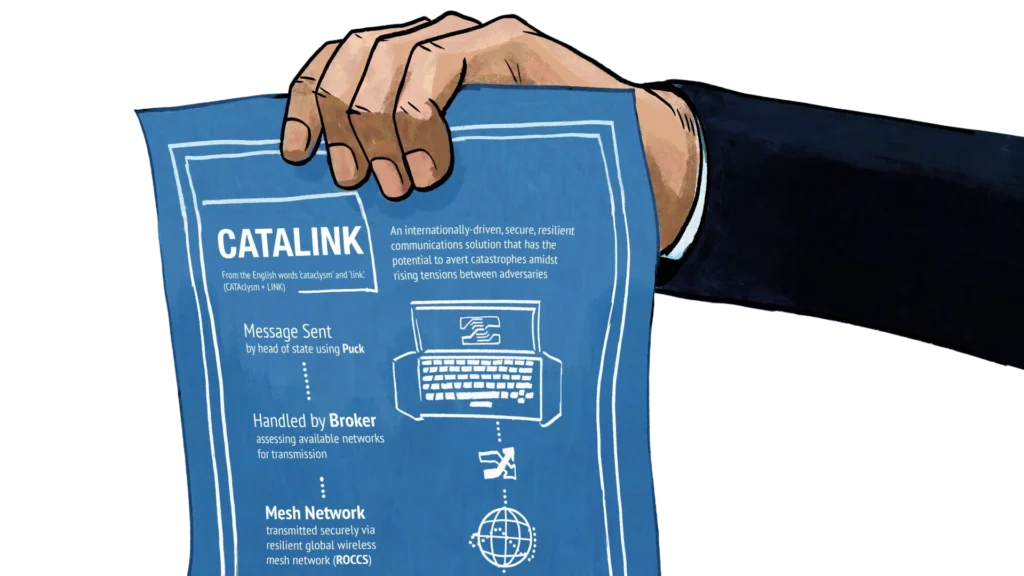
The CATALINK communications system is an internationally-driven, secure, and resilient communications solution that has the potential to avert catastrophes amidst rising tensions between adversaries. CATALINK would build on the “hotline” model of previous generations, and rely on open-source technologies to maximize user integrity and trust.
CATALINK is a novel approach to a modern, hotline-style crisis communication system that allows leaders of nuclear-armed states to communicate with each other – built to be secure, resilient, and trusted from the silicon up.
The Puck
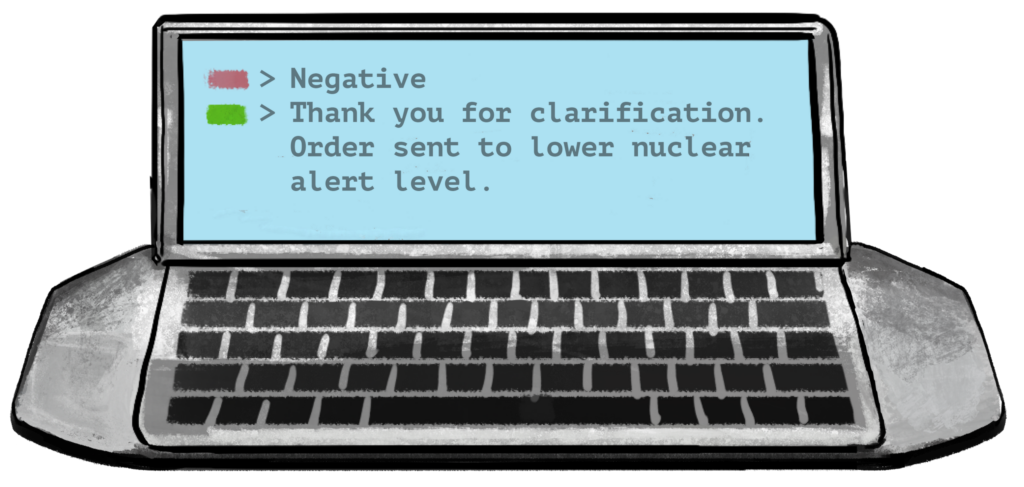
A simple, secure, and robust device meant for dedicated communication between global leaders and officials during a nuclear crisis or other high-stakes event, like disaster response. Designed on an open-source platform, it will send trusted messages in minutes.
The Broker
An interface between the Puck and the ROCCS, which determines the path of the Puck message throughout the desired network. The Broker will switch networks as needed, including between satellites, commercial networks, fiber-optic lines, and high-frequency or low-frequency radio bands. If/when all other options fail or are compromised, it can fall back to the ROCCS mesh network.
The ROCCS
Resilient Omni Frequency Crisis Communications System
A permanently active network that utilizes multiple channels and wavelengths to ensure reliable relays of Puck messages. The ROCCS is one of a variety of redundant networks through which the Puck messages may travel, depending on availability, the threat environment, and the type of message sent.
ORIGINS
Origins of CATALINK
The concept for CATALINK emerged during a workshop the Institute for Security and Technology (IST) convened at Stanford University’s Hoover Institution in 2019. The workshop, hosted in collaboration with Stanford’s Preventive Defense Project and the Nautilus Institute for Security and Sustainability, brought together multinational nuclear policymakers, academics, current and former senior decision-makers, and experts from the technology sector for discussions on global nuclear communications. Participants highlighted the technical vulnerability of communication systems–and discussed the potential solutions that could reinforce resilience and trust. A synthesis report from that workshop can be read here.
The unique combination of policymakers and technologists was critical to CATALINK’s origins. Today, that same mix continues to be a crucial source of advice and development for the blueprint of the CATALINK system.
Eric Grosse, former Vice-President, Security Engineering in Google has been instrumental in designing and developing the code of the Puck, and the code of Puck is accessible in open-source platforms like Github.
CONTEXT
Why are crisis communications important to nuclear risk reduction?
Any use of nuclear weapons, intentional or accidental, could have catastrophic consequences that impact all global citizens, not just those in nuclear-armed states. To reduce the risk of catastrophe we must provide decision-makers with every possible offramp. Crisis communications have historically been an essential tool to provide redundant and reliable channels of trust and security between nuclear-armed states, allowing for explanation, warning, and negotiation. Thus, nuclear-armed states need every possible tool available to promote trust, confidence, and accountability for nuclear risk reduction measures.
Nuclear-armed states, non-nuclear-armed states, and civil society organizations have frequently emphasized the importance of crisis communications in reducing nuclear escalation risks, and many highlight the need to enhance the resilience and number of connections between states. As stated in a variety of documents from the United Nations, the United States government, and coalitions of non-nuclear states, the consensus is clear: the world needs more secure multilateral hotlines. CATALINK could serve as a blueprint for what these improved channels could look like.
“We are ready to work with all relevant stakeholders towards the creation and enhancement of secure communication channels among the capitals of the nuclear-weapon states. This modest step, among others, can improve communication and transparency, including in a crisis.”
“…the nuclear-weapon States commit to the following immediate measures:… To create and enhance effective crisis prevention and management tools, including notification and data exchange agreements, enhanced leader-to-leader and military-to-military contact, the establishment of crisis-proof communication lines and risk reduction centres.”
HISTORY
History of Nuclear Hotlines
After the world came to the brink of nuclear war during the Cuban Missile Crisis in 1962, the United States and the Soviet Union agreed that the two superpowers did not have the ability to communicate effectively and swiftly in moments of crisis. To address this issue, officials set up the first nuclear direct communication link (DCL), or “hotline” between American and Soviet leaders in June 1963. The US-Soviet hotline has been used in various crises, including but not limited to John F. Kennedy’s assassination, the Six-Day War in 1967, the Indo-Pakistani War of 1971, and the Yom Kippur War in 1973. Further uses of the hotline are typically classified.
Building on the success of the US-Soviet direct line, other nuclear-armed states like France, the United Kingdom, India, Pakistan, and China later established various political and military leadership crisis communication channels with other nuclear and non-nuclear-armed states. States later adopted domain-specific hotlines such as the US-Russia and US-China space and cyber links. The technology of these crisis communication channels has also vastly improved through the decades. The first iteration of the hotline was a teletype system connected through a variety of land and sea-based cables. The hotlines were then upgraded to rely on satellite communications rather than landlines in the 1970s. The 1980s brought an added fax technology. The hotlines received their most recent upgrade in 2008, where the crisis communications system now relies on computer networks and allows email communication.
Timeline
START
AUGUST 1, 2021
The Most Beautiful Beaches In Goa
Contrary to popular belief, lorem ipsum is not simply random text. It has roots in a piece of classical latin.
JULY 11, 2021
Online Tax Filing For Your Business
It is a long established fact that a reader will be distracted by the readable content of a page.
MAY 27, 2021
Experiencing Cool And Boutique Australia Hotels In Winter
There are many variations of passages of lorem ipsum available, but the majority have suffered alteration.
END
1963 – The US-Soviet Union hotline begins operation 1963 – The Americans use the US-Soviet hotline for the first time after the assassination of John F. Kennedy 1966 – The Soviet-French hotline begins operation 1967 – The Soviet-British hotline begins operation 1967 – The US-Soviet hotline is used during the Six-Day War between Syria, Jordan, Egypt, and Israel 1971 – The United States and the Soviet Union sign the Accidents Measures Agreement to establish notification protocols for nuclear-related accidents using the hotline 1971 – US President Nixon uses the hotline with the Soviets during the Indo-Pakistani war 1972 – The United States and Soviet Union sign the Incidents at Sea Agreement, requiring prompt communication related to maritime activities 1973 – US President Nixon uses the hotline with the Soviets during the Yom Kippur War 1978 – The US-Soviet hotline gets a satellite upgrade 1984 – The US-Soviet hotline replaces the teletype machines with facsimile (fax) technology 1987 – The United States and Soviet Union established Nuclear Risk Reduction Centers (NRRCs) 1998 – The Russian-Chinese hotline begins operation 1998 – The US-Chinese hotline begins operation 2004 – The Indian-Pakistani hotline begins operation 2008 – The United States and Russia establish a dedicated computer network for the hotline, enabling email communication 2010 – The Indian-Chinese hotline begins operation 2015 – The United States and Russia set up the Syria deconfliction line (military-to-military line to prevent accidental clashes in Syria) 2015 – The US-Indian hotline begins operation 2015 – The US-Chinese space hotline begins operation
The United States and the Soviet Union sign the Accidents Measures Agreement to establish notification protocols for nuclear-related accidents using the hotline
Crisis communication agreement
1971
U.S. President Nixon uses the hotline with the Soviets during the Indo-Pakistani War
Hotline use
1972
The United States and Soviet Union sign the Incidents at Sea Agreement, requiring prompt communication related to maritime activities
Crisis communication agreement
1973
U.S. President Nixon uses the hotline with the Soviets during the Yom Kippur War
Hotline use
1978
The US-Soviet hotline gets a satellite upgrade, replacing cable connections
Hotline upgrade
1980s
1984
The US-Soviet hotline replaces the teletype machines with facsimile (fax) technology
Hotline upgrade
1987
The United States and Soviet Union establish Nuclear Risk Reduction Centers (NRRCs)
Crisis communication agreement
1990s
1998
The Russia-China hotline begins operation
New hotline
1998
The United States-China hotline begins operation
New hotline
2000s
2004
The India-Pakistan hotline begins operation
New hotline
2008
The United States and Russia establish a dedicated computer network for the hotline, enabling email communication for the first time
Hotline upgrade
2010s
2010
The India-China hotline begins operation
New hotline
2015
The United States and Russia set up the Syria deconfliction line — a military-to-military channel to prevent accidental clashes in Syria
New hotlineCrisis communication agreement
2015
The US-Indian hotline begins operation
New hotline
2015
The US-Chinese space hotline begins operation
New hotline
FAQS
Frequently Asked Questions
Learn more about CATALINK, the technical specifications, how it fits in the strategic landscape, and what’s next for the effort
What is CATALINK?
The CATALINK project builds an open source, additive, multilateral crisis communication technology for use by the leaders of nuclear weapons states. If implemented, CATALINK would build on the “hotline” model of previous generations, and rely on internationally-driven open-source technologies to maximize user integrity and trust.
What are the CATALINK components?
The Puck
A simple, secure, and robust device meant for dedicated communication between global leaders and officials during a nuclear crisis or other high-stakes events like disaster response. Designed with an open-source platform, the Puck will send text messages in minutes.
The Broker
An interface between the puck and the ROCCS which determines the path of the Puck message throughout the desired network.
The ROCCS (Resilient Omni Frequency Crisis Communications System)
A permanently active global mesh network, the ROCCS uses multiple channels/wavelengths to ensure reliable message relays; one of a variety of redundant networks for puck messages to use depending on availability, the threat environment, and the type of message sent.
Why is CATALINK needed?
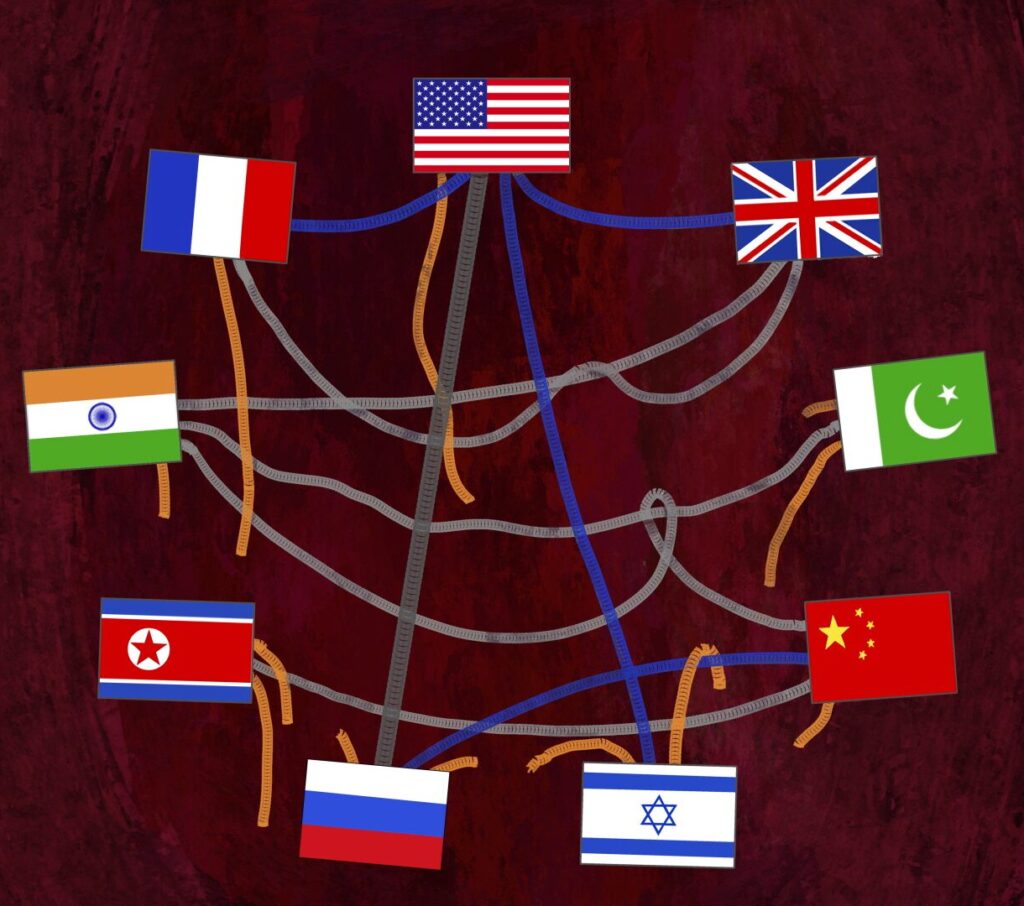
Not every country with nuclear weapons has a direct leader or military communication line with every other country with nuclear weapons. Additionally, there are no multilateral hotlines between states with nuclear weapons. Unlike the Cold War when security concerns were largely focused on one bilateral conflictual dyad, 21st century challenges are increasingly complex with multiple strategic competitors. CATALINK is an additive measure, not meant to replace existing hotlines but to add other resilient options for leaders to communicate before, during, and after a conflict or nuclear war.
Existing hotlines may be vulnerable to kinetic threats, such as environmental degradation or destruction during conflict, or non-kinetic threats such as cyber attacks and electronic warfare. New technological developments that could further destabilize communications (e.g. AI-generated audio and video) must also now be taken into account when thinking of how to improve resiliency, especially in a degraded security environment where miscommunication and misperceptions can flourish.
Hear what our team, advisors, funders, and officials have to say about the CATALINK initiative
Secure crisis communication is a linchpin in preventing nuclear catastrophe by ensuring clear, reliable, and protected channels for dialogue and decision-making. This is why Germany is honored to support IST’s groundbreaking efforts to address nuclear risks through innovative and pragmatic solutions. IST’s work on developing credible, resilient tools for multilateral crisis prevention and management is both visionary and essential.
Katrin Shimizu
Deputy Head of Division for Nuclear Disarmament, Arms Control, and Non-Proliferation at the German Federal Foreign Office
IST’s conceptual and practical work on credible, crisis-proof tools for multilateral crisis prevention and management is truly remarkable. By developing a concept for fostering secure communication lines and actionable measures, IST sets a strong foundation for managing future crises effectively. We deeply appreciate IST’s commitment to reducing nuclear risks and look forward to seeing their impactful work continue to shape a safer world.
Reto Wollenman
Swiss Federal Department of Foreign Affairs Deputy Head for Arms Control, Disarmament, and Cybersecurity
Secure crisis communication is a linchpin in preventing nuclear catastrophe by ensuring clear, reliable, and protected channels for dialogue and decision-making. This is why Germany is honored to support IST’s groundbreaking efforts to address nuclear risks through innovative and pragmatic solutions. IST’s work on developing credible, resilient tools for multilateral crisis prevention and management is both visionary and essential.
Katrin Shimizu
Deputy Head of Division for Nuclear Disarmament, Arms Control, and Non-Proliferation at the German Federal Foreign Office