Executive Summary
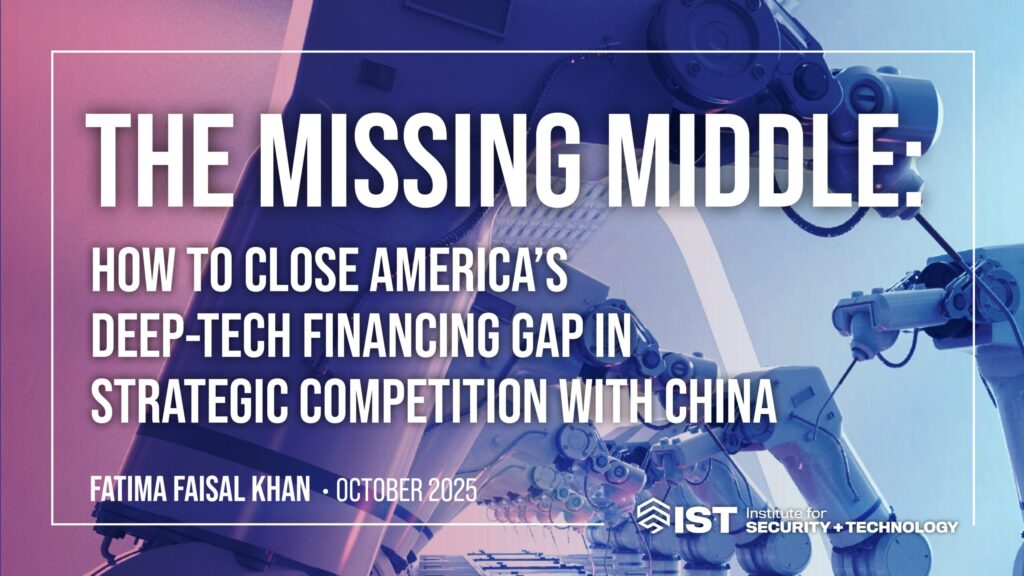
The United States and China are locked in competition to finance and deploy foundational technologies—advanced semiconductors, batteries, quantum computers, AI accelerators—that will underwrite economic leadership and ensure national security for decades. While America maintains leadership in breakthrough innovation, China has built the world’s largest state capital apparatus to capture manufacturing dominance in strategic sectors.
America’s Missing Middle Gap
American deep-tech companies excel at raising early-stage capital (such as the first $20 million to prove technology works) and late-stage financing (once operations are established), but face a systematic gap at the critical transition stage: the $50-$300 million needed to build first-of-a-kind commercial facilities. This is where laboratory prototypes must become manufacturable products, and where American companies repeatedly lose to Chinese competitors.
While U.S. companies spend 18 months navigating fragmented financing options, Chinese competitors access integrated state capital—policy banks providing patient financing at concessional rates with rapid approvals that enable faster market entry. The result: Chinese firms now control 76% of global lithium-ion battery production and 80%+ of solar panel manufacturing, despite American leadership in the early-stage research and prototyping that created these technologies. This reflects a systematic pattern: U.S. innovation discovers and validates breakthrough technologies; Chinese integrated capital captures their manufacturing scale-up.
China’s Bifurcated System
China’s deep-tech financing reveals both strengths and critical weaknesses. Policy banks effectively deploy patient capital for manufacturing scale-up in mature technologies. But the broader system suffers from political paralysis—the $47.5 billion semiconductor “Big Fund” was frozen for five months during 2022 corruption investigations. Of 2,107 government guidance funds totaling $940 billion, 66% of these funds have not made any investments. Top-tier venture capitalists now actively avoid government capital despite its availability.
Four Mechanisms to Win
This report identifies four targeted mechanisms to close America’s missing middle gap without replicating Chinese dysfunction:
- Patient Capital at Scale: $50 to 100 billion loan guarantee facility enabling 15-year financing at sub-3 percent rates for first-of-a-kind manufacturing, generating 5 to 10 times the private capital leverage
- Speed and Commitment Credibility: Six-month statutory approval deadlines with commitment protection, ending the uncertainty that currently paralyzes company planning
- Demand-Side Coordination: $20 to 30 billion in advanced purchase commitments across the Defense Department, Department of Energy, and General Services Administration, removing revenue risk and unlocking 10 to 20 times private investment leverage
- Technology Maturity Demonstration: $500 million to $1 billion annual program for targeted grants ($10 million to $50 million each) proving technology readiness at critical inflection points
These mechanisms preserve venture capital’s strengths at financing early-stage, risky technologies while addressing specific gaps venture capital cannot fill. Success requires partnership without control—letting private investors identify technologies while public capital provides patient financing, credible demand signals, and maturity validation that unlock substantially larger private capital flows.
The Strategic Opportunity
China has shown the missing middle can be addressed with state capital. America must address this challenge more efficiently–combining venture dynamism with patient capital, achieving coordination without centralization, and demonstrating that partnership outperforms control. Four mechanisms merit policymakers’ immediate attention. Implementation will determine whether American innovation translates to manufacturing leadership or Chinese integrated capital continues capturing the commanding heights of strategic technology sectors.
The Missing Middle: Number of Deals and Average Deal Size
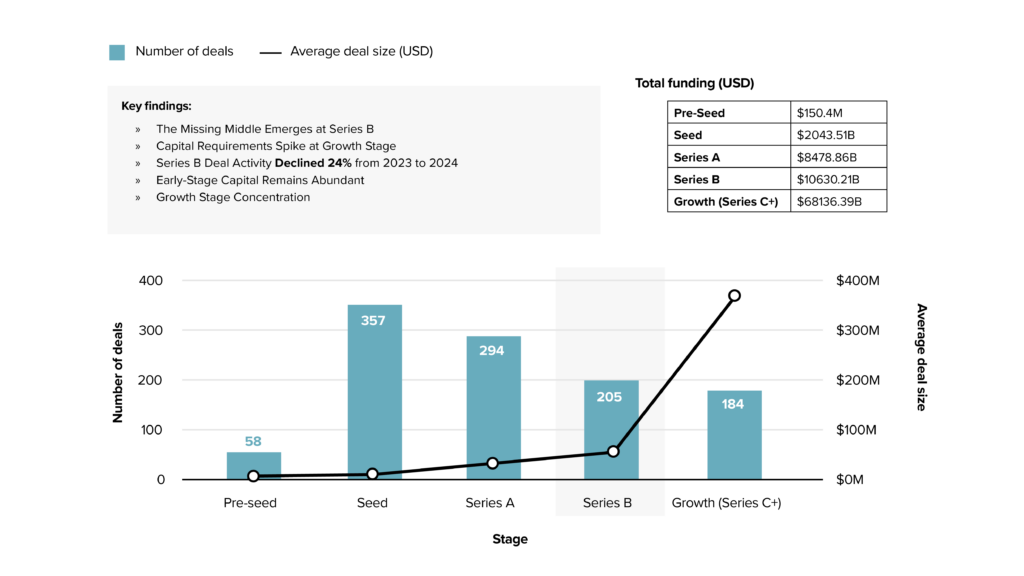
See Appendix B in the report for more information.