
Many people recognize “Silicon Valley” as a technological hotbed, but few understand how tech companies are funded. How much money is required? Who provides the capital? And what information, rights, or other benefits do funders receive in exchange for their support? We are living through an industrial revolution defined by rapid, simultaneous advances in emerging technologies that can serve both military and civilian applications. As such, there is heightened interest in understanding who has access to the technology and by what means.
In the past decade, Chinese capital has flooded U.S. and global technology ecosystems at record levels–buoyed by massive currency reserves and determined Chinese government leadership. For example, in 2015, Chinese sources of venture capital accounted for 16% of all venture deals in the U.S. Since 2018, U.S. policymakers have introduced legislation and executive actions to hone in on vectors for technology transfer to the People’s Republic of China.
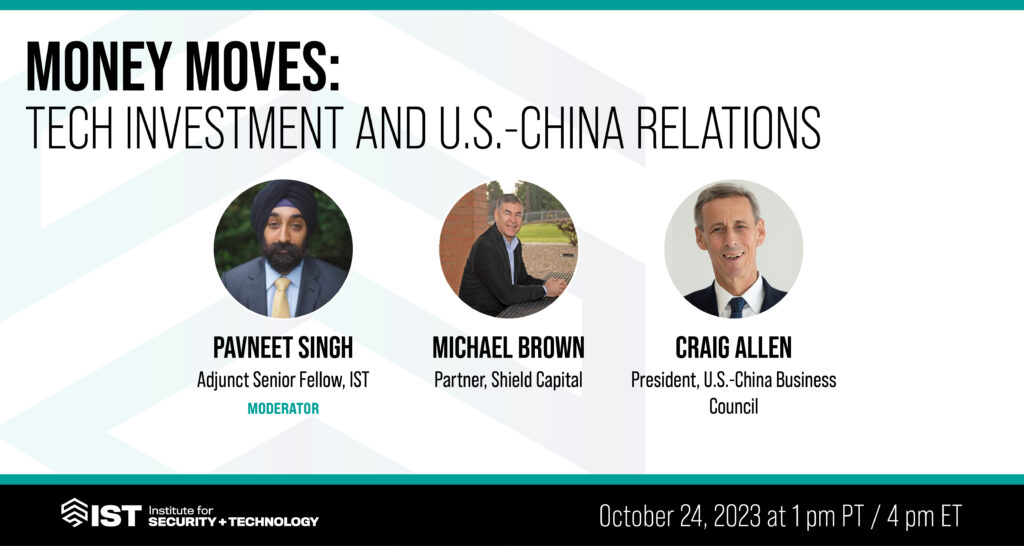
On October 24, Michael Brown, Partner at Shield Capital and former Ambassador Craig Allen, President of the U.S.-China Business Council, sat in conversation with IST Advisor Pavneet Singh to discuss the role of investment in the technology competition between the U.S. and China. Vice President for Geostrategic Risk Ben Purser kicked off the discussion with an introduction to IST’s Strategic Balancing Initiative.
What is the concern for U.S. policymakers about Chinese investment in U.S. early stage technology companies? What were the effects of the Foreign Investment Risk Review Modernization Act on Chinese investment? How are U.S. companies faring in the Chinese market? And is the U.S. equipped to compete in the economic and financial domain?