
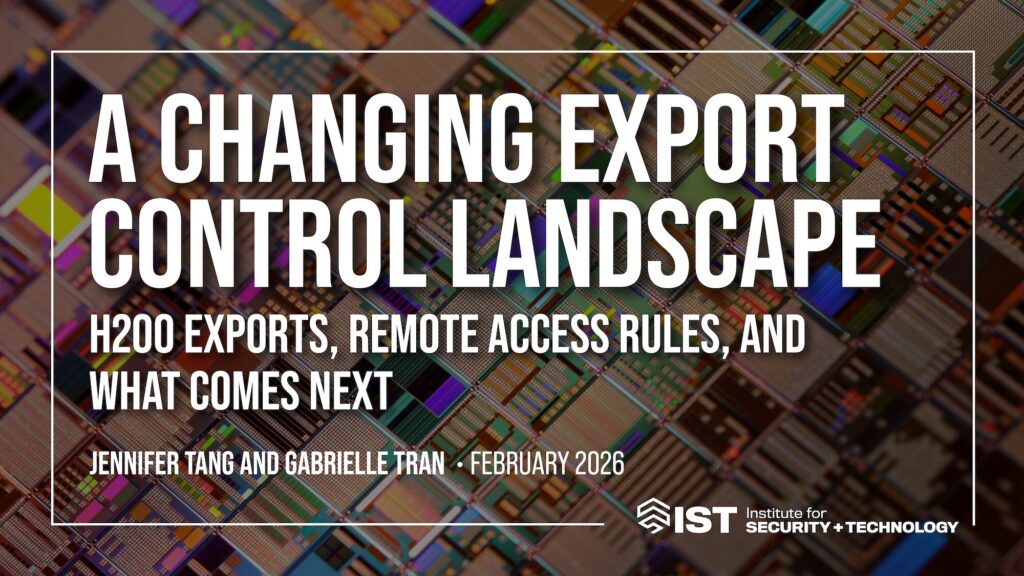
January 2026 underscored how quickly U.S. AI export controls are evolving. Two developments in particular—licensing that reopened a pathway for Nvidia’s H200 sales to China and growing congressional interest in restricting remote cloud access to advanced compute—signal an export-control agenda in motion, expanding in both ambition and underlying tradecraft. Taken together, they sent mixed signals about what the United States is ultimately trying to accomplish, and how far it is willing to go to shape outcomes beyond the point of shipment.
Key Takeaways
IST’s AI Export Control Initiative has been tracking these shifts closely, including through working group discussions focused on what implementation and enforcement actually looks like in practice. These discussions highlight several critical shifts and challenges for U.S. policymakers in managing AI export controls:
- The decision to sell H200s to China helps Chinese AI firms offset its compute shortcomings to train frontier AI models in the short-term. At the same time, the policy does not accomplish its ostensible long-term goal of ensuring that Chinese entities continue using U.S.-designed chips into the future, as the policy does not appear to be altering China’s push to indigenize its AI stack.
- Restricting remote access marks a shift from blocking discrete chip shipments to managing both the accumulation and use of advanced compute over time, making the regime more operational and compliance driven. These restrictions also create real tradeoffs between commercial competitiveness, innovation, national security risk reduction, and credibility.
- Cloud-based remote access to high-end compute is now a path of least resistance for restricted entities seeking to bypass physical chip exports. The Remote Security Access Act, which is currently being considered by Congress, aims to clarify that certain forms of foreign remote access to U.S.-hosted compute fall within the scope of U.S. export control authority. Implementation would require increased Know Your Customer (KYC)-style requirements.
- The policy to sell H200s to China creates ambiguity and enforcement challenges. It also increases the quantity of high-end chips available to China that it would not otherwise have access to, thereby increasing its ability to develop better frontier AI models. At the same time, the new H200 licensing requirements remain difficult to audit and enforce once the chips are in China.
- China will continue to retain significant strategic leverage in spite of these policy changes. Beijing can use its own mandates (like selectively approving imports or conditioning them on purchases of domestic alternatives) to limit the widespread adoption of U.S. chips and support the indigenization of its AI stack.
- U.S. coordination remains in flux, raising a harder operational question: in a regime that increasingly depends on timely, granular insight rather than binary limitations, is the Intelligence Community now the best-positioned actor to underwrite enforcement credibility? Looming over all of this is a more fundamental uncertainty that policy has yet to resolve: what is the desired end state of U.S. export controls, and how should success be measured?
These shifts create real tradeoffs between national security and commercial competitiveness. In this policy memo, we assess recent adjustments to U.S. AI export controls, evaluate their internal coherence relative to stated policy objectives, and share IST’s AI Export Controls Initiative working group members’ insights and observations.