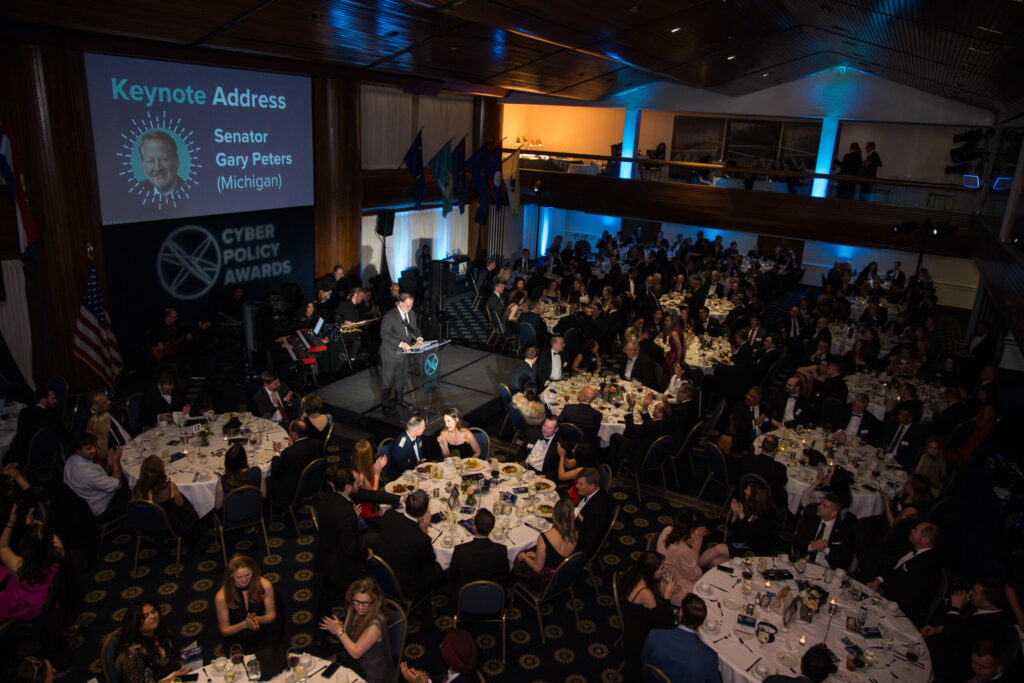
The Cyber Policy Awards™ organizing committee is pleased to announce selection of 23 finalists who are in contention to receive The Atlas trophy, chosen by an august panel of judges from across the cyber community. The winners in each category will be revealed and celebrated at a gala event on the evening of Thursday, February 5, 2026 at the National Press Club in Washington, DC. Request your invitation to attend.
During an open nomination period lasting one month, the cyber policy community and broader public were invited to nominate an individual, small group, or organization who demonstrated impact during 2025 in the below categories. After careful review of 85 submissions, the judges have selected this year’s finalists.
“The Cyber Policy Awards belong to the entire community. With open nominations, transparent procedures, and an independent panel of judges, this is truly a celebration of excellence by and for those working to make cyberspace more secure and resilient,” said organizing committee chairman Steve Kelly. “IST is honored to facilitate this recognition, but the community itself determines who deserves these honors.”
The award for U.S. Domestic Policy Impact recognizes those whose efforts have had significant impact on the U.S. domestic policy landscape, such as by materially influencing the community’s thinking and trajectory, overcoming a longstanding and intractable obstacle, or galvanizing broad stakeholder support to take some action. In no particular order, the finalists are as follows:
- Colin Ahern for his comprehensive efforts to protect New York State critical infrastructure
- Alexandra Seymour, Emily Park, John Miller, and Mike Flynn for their various efforts to advance and safeguard cybersecurity information sharing
- Michael Geraghty for transformation of New Jersey’s cybersecurity posture, delivering measurable economic and security impact
The award for International Policy Impact recognizes those whose efforts have had significant impact on the international policy landscape, such as a shift in international narratives, viewpoints, or prioritization; the emergence of international consensus or an agreement; or resulting in collective action when previously unlikely. In no particular order, the finalists are as follows:
- Australian Signals Directorate and the Australian Cyber Security Centre for elevating critical infrastructure resilience from technical checklist to global policy imperative
- Will Mayes, Ciaran Martin, James Burns, Edward Lewis, and Ruth Goodwin for establishing the Cyber Monitoring Centre to categorize and measure the impact of major cyber incidents1
- Rear Admiral (ret.) Mark Montgomery for cyber leadership in practice, from Ukraine’s frontlines to the Indo-Pacific
- Matthew Rogers for driving worldwide adoption of secure-by-demand principles for operational technology systems
The award for International Partnership recognizes those who have demonstrated a unique level of commitment to, or teamwork with, a foreign entity regarding a cyber-related foreign policy issue or a significant cybersecurity challenge. In no particular order, the finalists are as follows:
- Digi Americas Alliance and the Frente Parlamentar de Apoio à Cibersegurança e Defesa Cibernética (FPCibserg) for shaping Brazil’s cybersecurity and AI governance framework through private-sector and legislative collaboration
- The Global Forum for Cyber Expertise (GFCE) for uniting global stakeholders to more effectively build cyber capacity
- The Cyber Defense Assistance Collaborative (CDAC) for creative scaling of private sector assistance to Ukraine
- Dr. Kubo Mačák, Tomáš Minárik, and Otakar Horák for leading an international collaboration on cyber-related issues of international law through the Cyber Law Toolkit, fostering shared understandings across regions and legal traditions
The award for Ecosystem Champion recognizes those whose tenacious efforts have led to broad structural and long-lasting positive impact on the cyber ecosystem through policy changes or by putting policy into action at scale; or those who enable the ecosystem-impacting work of academic institutions, think tanks, or other civil society organizations through significant financial or in-kind support. In no particular order, the finalists are as follows:
- Philip Reitinger for championing the cybersecurity nonprofits ecosystem
- Thomas Billington for facilitating trusted collaboration and advocacy to strengthen U.S. and allied cyber resilience
- Building Cybersecurity for its commitment to enhancing human safety in the connected built environment
- United States Department of Navy’s Chief Technology Officer team for scaling zero trust architecture, operational resilience, and innovation adoption across the U.S. Navy and beyond
The award for Research Impact recognizes those whose novel scholarly research has led to a conclusion, discovery, concept, tool, approach, or proposal that can be shown to have advanced or made a substantial contribution to domestic or international cyber policy. In no particular order, the finalists are as follows:
- Dr. Fred Heiding, Alex O’Neill, and Lachlan Price for creating the Cybersecurity Strategy Scorecard to guide nations in building effective cyber policies
- Wenyi Morty Zhang, Annie Dai, Dr. Keegan Ryan, Dr. Dave Levin, Dr. Nadia Heninger, and Dr. Aaron Schulman for their groundbreaking research exposing critical vulnerabilities in GEO satellite links
- Cheri Caddy, Ginger Wright, Benjamin R. Lampe, Andrew Ginter, and Andrew Ohrt for advancing cybersecurity for physical systems through Cyber-Informed Engineering
- Jamie MacColl for championing evidence-based research to shape cybersecurity and sanctions strategy in the UK and beyond
The award for Excellence in Journalism recognizes journalists who positively contributed to their readership’s understanding of complex cyber policy issues by correctly detailing technical aspects, drawing complex connections with other relevant events and proceedings, fairly representing tradeoffs and divergent viewpoints, and accurately reflecting policy substance. In no particular order, the finalists are as follows:
- Dina Temple-Raston, Sean Powers, Megan Detrie, and Karen Duffin (CLICK HERE podcast) for their coverage of North Korea’s secret army of hackers
- Jenna McLaughlin (NPR) for investigative reporting of unauthorized data access at the National Labor Relations Board and its cybersecurity implications
- Renee Dudley and Doris Burke (ProPublica) for investigative reporting uncovering the Pentagon’s reliance on Chinese contractors for cloud work [Note: The nominees have withdrawn from consideration pursuant to ProPublica’s code of ethics.]
- Brian Krebs (Krebs on Security) for significant contributions to the strategic and tactical understanding of cyber criminality
The award for Lifetime Achievement recognizes those who had a sustained and significant impact on domestic or international cyber policy over the course of their career. Such impact might be evidenced by contributions on numerous issues, a long-term sustained effort on a single issue that eventually culminated in a watershed development, or a combination thereof. Recipients of this award will be listed as members of the Cyber Policy Awards™ Hall of Fame. The recipient’s duration of impactful service must equal or exceed 25 years.
- The judges have selected an individual to receive the Lifetime Achievement award whose identity will be revealed during the ceremony. In accordance with the Cyber Policy Awards™ rules and selection procedures for this category, runners up will be held for future consideration and not publicly announced.
1 Judge Ciaran Martin recused himself from this category’s deliberations in accordance with our ethics and transparency policies. Organizing committee members and judges cannot receive individual awards but may be part of group awards.
The Atlas Statuette
Recipients will receive the Cyber Policy Award of Merit, which features The Atlas statuette representing the ultimate symbol of strength and endurance. The Ancient Greek Titan Atlas bears the cosmos and turns the sky on his shoulders for eternity. Atlas’ burden represents the skill, strength, and commitment required to positively influence domestic and international cyber policy.
For more information about the Cyber Policy Awards™, including rules and procedures, visit www.cyberpolicyawards.org.
Sponsors
Platinum
- Microsoft
- Craig Newmark Philanthropies
Gold Level
- Forescout
Silver Level
- AT&T
- Venable LLP and the Center for Cybersecurity Policy and Law
- GDIT
Bronze
- AWS