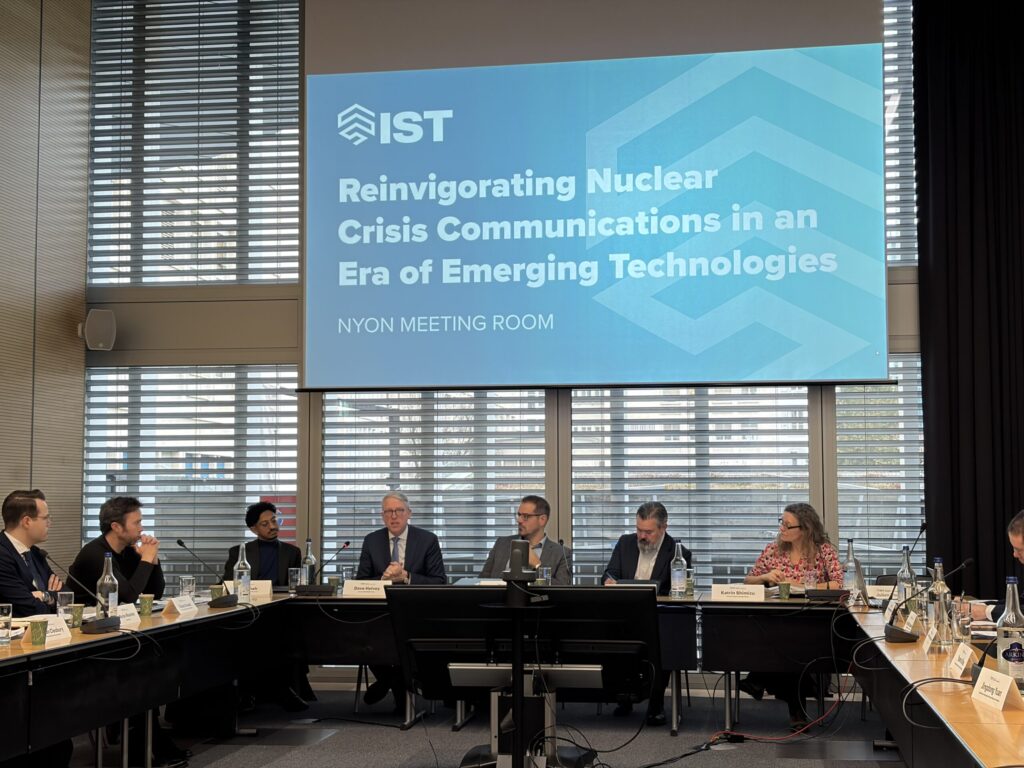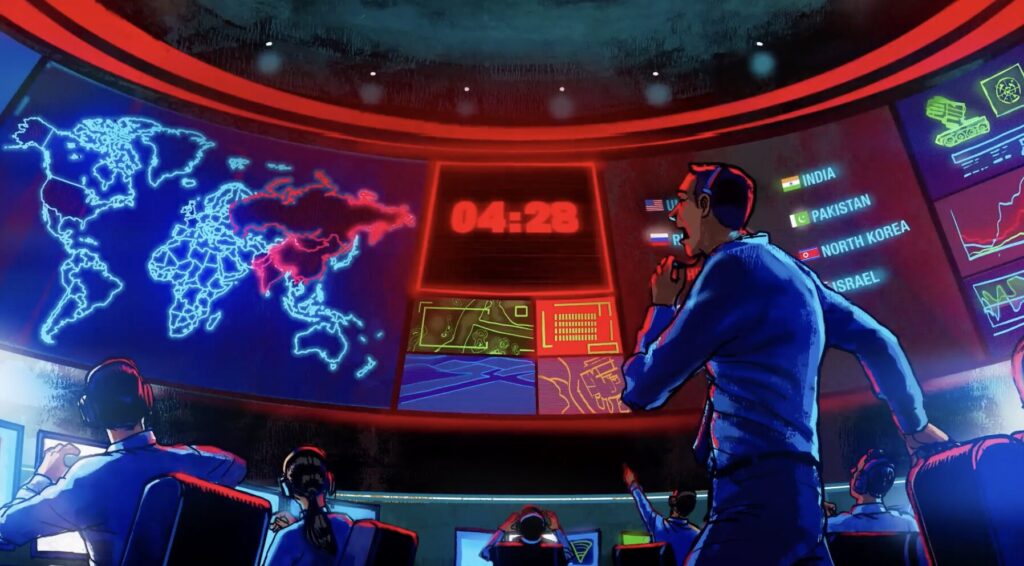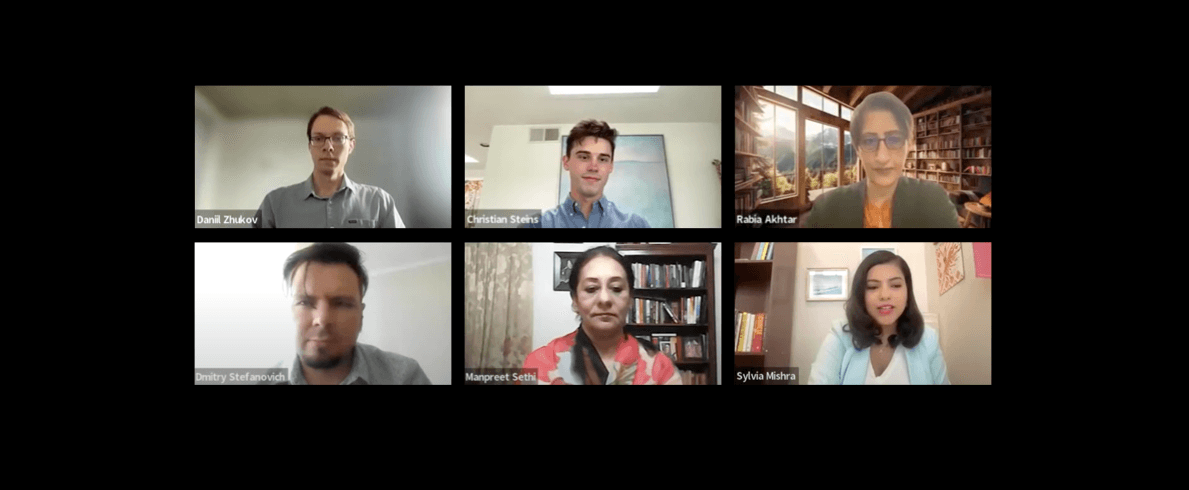
On Thursday, July 19, the Institute for Security and Technology (IST)’s CATALINK Initiative held a virtual event with the authors of their latest report series, Improving Nuclear Hotlines: Relevance and Use Cases, to discuss the state of crisis communications in India, Pakistan, Russia, and the United States, United Kingdom, and France.
Christian Steins, IST’s Technology Policy Analyst, kicked off the webinar with an introduction to the CATALINK Initiative, and this latest project. “The guiding idea behind these reports was to think through and build out use case scenarios,” he said.
Sylvia Mishra, IST’s Deputy Director of Nuclear Policy moderating the webinar, explained the motivation for the briefs, saying, “we were asked several times by stakeholders in the field and also experts, at what point of time during a crisis would a multilateral crisis communications come into use?”
Improving Nuclear Hotlines: Relevance and Use-Cases comprises a series of short briefs and interviews authored by members of CATALINK’s Crisis Communications Resilience Working Group, and edited by Mishra and Steins. Established in October 2023, the working group is a network of experts and practitioners who work collaboratively to augment nuclear risk reduction efforts.
Together, the series assesses the status of crisis communications systems in specific nuclear-armed states, present potential use case scenarios of multilateral crisis communications, and examine the current operating environments and political and technical barriers to cooperation in each state of focus.
During Thursday’s conversation, Mishra’s first question was for Dr. Manpreet Sethi: Could a multilateral crisis comms be established in South Asia? Mishra mentioned that even though the Directorate General of Military Operations hotlines between India and Pakistan exchange messages habitually on a weekly basis, “there is some doubt about the effectiveness of these channels and the validity of the information being exchanged.” How can this challenge be overcome?
Dr. Sethi’s brief, Resilient Nuclear Crisis Communications: India’s Experience, examined the history of the nuclear relationship between India and Pakistan. The relationship has so deteriorated, she said Thursday, that the two countries refuse to communicate via hotlines. “The Indian experience has been [one in which] Pakistan has deliberately worked towards masking its real intent, or indulging in bluster or consciously trying to mislead,” Dr. Sethi said, citing incidents during the 1999 Kargil conflict.
Dr. Rabia Akhtar’s brief, Pakistan: Mitigating Nuclear Risks Through Crisis Communications, highlighted the importance of third parties, especially the United States and China in establishing crisis comms between rivals. Dr. Akhtar explained how the United States has acted as an intermediary between India and Pakistan, but no channel has been formalized due to the lack of trust between the two.
“Such a mechanism…would provide a platform for dialogue as well as negotiation,” she said. “Regular, structured engagement within a multilateral framework can help build trust over time as parties witness consistent and fair behavior from all involved.”
But why are formal crisis communications even necessary?
“Whenever there is a crisis between nuclear powers, it is effectively a nuclear crisis,” said Dmitry Stefanovich. Stefanovich’s brief Use-Cases of Resilient Nuclear Crisis Communications: A View from Russia provided a history of Russia’s use of and approach to crisis communications systems.
“The officials need to be constantly in touch…. simply because I’m confident that any nuclear weapon state has no interest in having a direct confrontation.” Stefanovich continued, “Because ultimately, we know where that will lead us.”
The Phone-a-Friend Option: Use Cases for a US-UK-French Crisis Communication Channel by Daniil Zhukov proposed a trilateral channel among the United States, United Kingdom, and France. During the discussion, he emphasized how communication among allies is as important as communicating with a rival, especially to avoid instances of miscommunication.
“As information moves much more rapidly through public space, social media, et cetera, this kind of communication that’s resilient, swift and redundant between allies also needs to happen much more swiftly,” Zhukov said. “I think we need to envision different scenarios for policymakers and their staff that demonstrate the importance of such channels being upgraded.”
Throughout their discussion, the panelists agreed that there needs to be greater awareness on the threat of emerging technologies and how they can undermine the security and resilience of crisis communication channels. Panelists also underscored the need for a shared understanding of threat perceptions, and efforts to reimagine arms control for states to work together on multilateral crisis communications. An audience Q&A session generated further questions on political will and utility surrounding hotlines, the absence of hotlines during the Brahmos missile incident, and the potential ways to make hotlines more secure and robust.
IST looks forward to continuing our work championing additive multilateral communications systems around the world.
Watch Improving Nuclear Hotlines: Experts Speak, for the full discussion: