
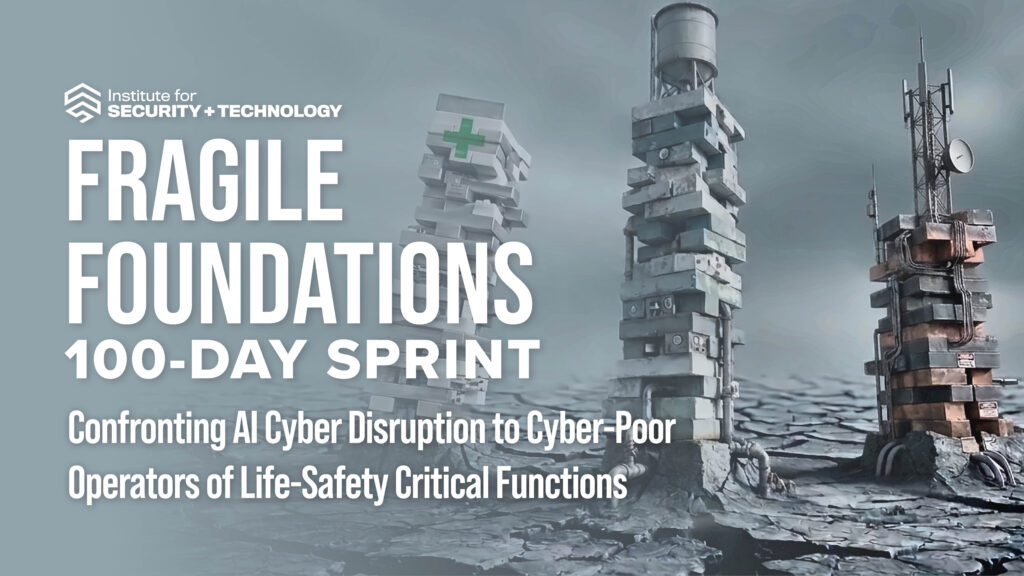
The emergence of powerful cyber-capable AI tools is creating significant national security and public health and safety challenges. A dangerous asymmetry has emerged as frontier AI advances the ability to discover and exploit software vulnerabilities at scale and considerably faster than our ability to defend against them. Layered on top of decades of technical debt, nowhere is the threat more urgent than in the inherently fragile Operational Technology and Industrial Control System environments that run much of our nation’s critical infrastructure. The operators of these life-safety critical functions are often target-rich and cyber-poor: responsible for high-value systems that attract attackers, yet lacking the incentives, resources, or awareness to defend against them.
In September 2026, the Institute for Security and Technology’s (IST) Center for Advancing Cybersecurity (CfAC) launched the Fragile Foundations Sprint, a 100-day, multi-stakeholder effort grounded in the real-world experience of operators and those who support them on the frontlines. Now, with the Sprint coming to a close, join us as we release its findings and recommendations for policymakers.
Leaders from all five working groups will share what they learned and what they recommend:
Sprint architect Joshua Corman and CfAC President Nick Leiserson will be joined by a life-safety critical function operator and co-chairs of the Fragile Foundations Working Groups to explore the challenges and opportunities facing our life-safety critical functions in the AI era. We will also discuss how to build on the groundwork of the Sprint to further shore up life-safety critical function operators. This is just the beginning. Join the event to see how you can play a role in building life-safety critical function resilience.
Location: U.S. Capitol Building, Washington DC
Time: 9:00 – 10:30 AM ET