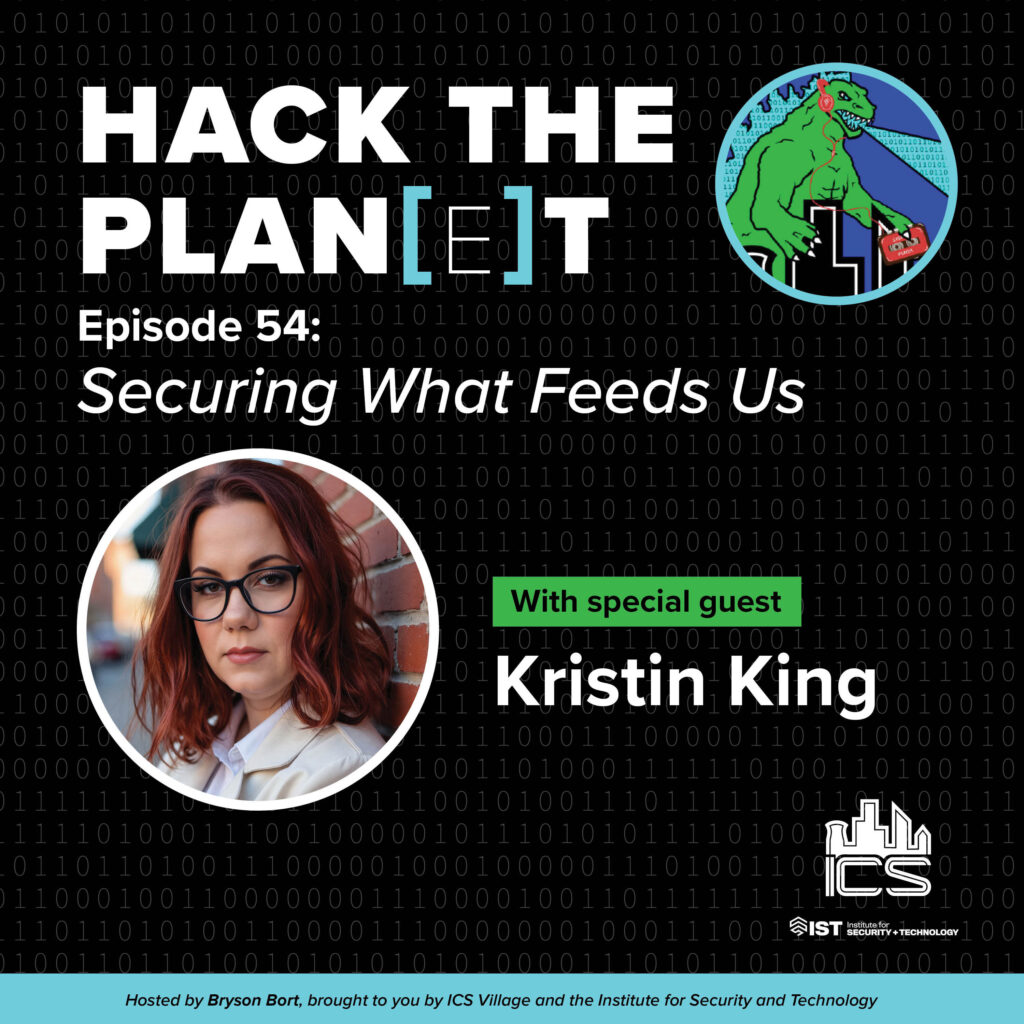
In this episode, Bryson Bort talks with Kristin King, technologist, environmental manager, and host of the Bites and Bytes podcast, on why food and agriculture remain a dangerously overlooked piece of critical infrastructure. Kristin explains how human emotional responses drive social engineering, how rapidly expanding OT and connected tech in farms, factories, and fisheries create new attack surfaces, and what the JBS ransomware attack reveals about cascading risks from animal welfare to empty grocery shelves. She also offers a preview into her forthcoming book Securing What Feeds Us, outlining a path from today’s cyber-physical vulnerabilities toward better policy, shared language, and a new generation of “food cybersecurity” practitioners.
“We are creating the potential for a foodborne illness to happen from a cyber attack that may not be noted,” Kristin said.
Join us for this and more on this episode of Hack the Plan[e]t.
The views and opinions expressed in this podcast represent those of the speaker(s) and do not necessarily represent the views and opinions of their employers.
Hack the Plant is brought to you by ICS Village and the Institute for Security and Technology.
Transcript
Bryson Bort: Today, I’m joined by Kristin King, founder and host of the Bites and Bytes podcast, and author of Securing What Feeds Us: Cybersecurity in Food and Agriculture. Drawing from an eclectic background that spans desktop support, environmental management, food production, and even behavioral observation of bachelor gorillas at the zoo, Kristin offers a unique perspective on the intersection of human behavior and critical infrastructure protection.
Together, we explore how the critical food and agriculture sector remains dangerously underregulated and overlooked, and why applying behavioral psychology and common cybersecurity frameworks to farms, fisheries, and processing plants is essential to securing our global food supply.
How did observing zoo patrons interact with gorillas reveal why human emotional reactions drive social engineering success? Why is the lack of a common standardized cybersecurity language creating dangerous communication gaps across agricultural settings? How did a ransomware attack against JBS leave cattle stranded in trailers and wipe out meat supplies overseas?
Join us for this and more on this episode of Hack the Plant.
Kristin King: My name is Kristin King. I am originally from New England. I was born in Maine, and I grew up in Massachusetts. I’ve lived all over the U.S. except for the West Coast. Oddly enough, I currently reside in Northern Virginia in wine country, which is very nice. So, very agricultural and rural in a lot of ways, but also close enough that you could still get into trouble, as I always say. I have a degree in environmental management, which I got while I was an adult learner. So I didn’t go straight out of high school and get my degree like quote normal people do. I guess school was hard for me. I kept questioning why I needed to know this because how does this apply to my everyday life, and so I think I had a little bit of a conflict of interest, probably when I came out of high school to do that. I have spent over 25 years in technology. I started in troubleshooting and desktop support and that kind of thing. I even drove Geekmobiles around Washington, D.C., and the Baltimore area for a while, and worked my way up to corporate there. Jumped out, did a bunch of consulting work. Then the market crashed in 2009, I believe it was, and that’s when I went back to school for my degree in environmental management. The funny thing is that I always say this: I tried to get a degree that had nothing to do with what I was doing. That’s an absolute joke on me now because I use it quite frequently, especially in operational technology spaces and industrial environments. To understand environmental management is really helpful, especially with, you know, any type of chemical or water treatment or agricultural situations. While I was finishing my degree, I had the privilege to work with a troop of bachelor gorillas at the Louisville Zoo with an emeritus professor who was studying cortisol levels in bachelor troops, and I got to spend a lot of time in different zoo atmospheres. I’ve worked at the commissary at the National Zoo. It was some of the best times. It was like my favorite job I’ve ever had, and I made absolutely no money as a research associate, and it wasn’t just because I was sitting with animals, because I got to watch people watch animals, which really informed me on how to work with behavior modification when it comes to cybersecurity. Because let’s face it, we’re dealing with social engineering pretty much the majority of the time, beyond other things we deal with, and then I started working in food production, and then I moved into Sony, and then I moved into consulting, as one always does in this field, and then I started my own company, which led me to do the Bites and Bytes podcast, which led me to get contacted by Wiley Publishing to write my book, Securing What Feeds Us: Cybersecurity in Food and Agriculture, which is out in September of this year, the 29th.
Bryson: So let’s pick on the social engineering aspect that you talked about. You said at the zoo that you learned behavioral modification by watching people watch animals. I would have thought that in reverse. So what exactly did you see? What did you learn, and how do you apply that in the cybersecurity field?
Kristin: I think human beings have a very misunderstood view of what animals are and what they do in the wild because we have TV and movies, and we have a lot of different ways of manipulating animal behavior. Deepfake AI videos are very prominent right now of showing animal behavior being incorrect is another example, another layer to this, and banging on the glass and then expecting an animal to do something because you bang on the glass is absolutely absurd to me. These are wild animals. Yes, they’re in a zoo, but they’re not domesticated. They don’t perform tricks unless that is part of their function and behavior modification that they’re working with. Gorillas, for example, are not trained. They don’t care about you. Trust me, they don’t care. And one day, and here’s a story for you. I was sitting behind the mesh in a little box that was sort of in the enclosure, but sort of not in the enclosure. It’s just an observation area, and the patrons could see me watching the gorillas. So basically, the patrons were watching the gorillas watch me watch the gorillas. It was kind of wild, and the boys were in front of me. They were just doing what they do, eating their gorilla salad or sitting there sleeping, whatever, whatever they were doing. And I was doing focal observations on one, and I happened to be doing a focal observation on one particular individual who was the youngest in that troop, who was getting really irritated by the patrons, just sort of like, get away from me, I’m busy kind of moment — and they kept banging on the glass at me, and then making a little turn symbol, and then a camera signal, so that I would get the girl in front of me to turn around so they could take a photo of it. Okay, you try getting a 400 to 600 pound animal to do anything, just anything, without any kind of incentive at all. And I looked at them, and I said, “No, I kind of made them think the nose symbol. Like I’m not doing that. And I ignored them. They flicked me off and banged on my glass again and walked away, and it really kind of got me thinking about how we interact with things when we’re upset, so the emotional response to things, and then it got me thinking about how we interact with other things in our life that are very similar. You know, do we go from zero to 100 in like three seconds? Do we meet anger with curiosity, or do we meet it with more anger and rage? And watching the grill has taught me a lot about that. They didn’t really meet things with anger; they met them with curiosity because they were like, “What’s this thing? If I poke it, what happens? You know that thing, and it made me realize that human beings have kind of like missed that curiosity feel again, that they just jump straight in. So social engineering is—it’s just preying on that particular aspect: our emotional reaction to things, how we believe things right away, rather than actually having a critical curiosity towards them, rather than a reaction. So how do phishing emails happen so easily? It’s how we’ve been able to have most of the breaches that we’ve had is because it’s preyed upon, you know, the people’s reactions to it, whether it’s negative or positive, for that matter. One of my other favorite reactions and interactions I’ve had with patrons is: at the time, I had really long black hair. This is—it’s relevant. Hold on. And I was out on the outside of the mesh, so I was on patron face inside of a glass. And these elderly women, probably in their late 70s, came over and they’re introducing themselves to me and saying that they are really excited to see a woman, you know, doing this work, and I was very honored and humbled. And one woman said, “Oh, can I ask you a question? I said, “Of course. And she goes, “Do you think that the gorillas are attracted to you because of your long black hair? I had to take a real beat inside my brain and not be disrespectful or laugh. And so I said, “I met it with curiosity myself, and I said, “No, actually, these are lowland gorillas. They prefer short hair over long. If it was a mountain gorilla, maybe that would be a different conversation. I winked at her, and I said thank you. She was satisfied with the answer and walked away. I walked back into the keeper’s back room behind the scenes, and I told them what happened. And I tell you, when they laughed so hard, there were tears. People were howling, laughing. It was unbelievable, but it made me again, realize that how we view things is through our own world lens, and I can’t expect everybody to look at things the same way I do versus what they look through. So it really taught me a lot about how to interact with people and meet them where they are, rather than like, oh, you’re so stupid. I can’t believe you’d ask me a dumb question like that. I actually kind of thought it was a beautiful question at the end of it, and I still to this day smile as you see while I’m telling you the story.
Bryson: So transitioning to the book, you have your own podcast, Bites and Bytes. Why don’t we talk about that, because that’s how you got approached by Wiley to publish the book on agricultural security.
Kristin: Sure, Bites and Bytes was really kind of started up because I kept having these same conversations over and over again, and I kind of thought, well, why don’t I just put them on air, and then we can start having a repository of these conversations? Because if you go to search right now on the internet, or look in the library, or anywhere you go to get your research, it’s very hard to find conversations about cybersecurity in food and agriculture. You’ll find piecemeal stuff, but there’s really no central place. So I was like, “Well, at least I could put it in a podcast format, and we could start there. The podcast is going into its third year. I’m almost up to my 50th episode. It’s very cool. Also exhausting because I do everything myself. I mean, I do everything myself: promotion, editing, finding the guests, curating the whole thing, down to the music. The music is curated to each of my guests and the subject matter. So that was out and going, and happily people like it. So that’s great. Wiley approached me over email, and I know that, like, you can go out to Wiley and you can pitch your ideas and stuff. I wasn’t expecting to write a book for at least another year because I wanted more time. I needed more time, and I got the email. It was so funny, right? So because I was like, I literally responded back, and I was like, “Is this a joke? Are you like a scammer? Like, what’s going on? I actually had to look up the person who sent it and was real. She worked at Wiley, and she got on a call with me, and I started laughing with her. I said, I really was wondering if this was going to be just a scam. Are you going to ask me to give you money to help you do this? And she’s like, No, no, no, Kristin. We really, really want you to write this book. And I was like, Okay, I think you guys are all crazy. Just so you know up front, and then the next thing I knew, I had a contract in front of me, and then I had my six-man team ready to go on the phone, and they were really excited. They still are. They’re really excited about everything that’s happening with the book. They’ve been pleasantly surprised. I have a very high number of pre-sales already, which is usually pretty unheard of for a first-time author. So that just means that people, to me, and I cry every time somebody sends me a receipt of purchase. By the way, like, legitimately have a tear moment. It just to me, it just signals that people are supporting the work and they want to be part of the journey, and that is that means more than anything to me because I am on an island a lot and I am alone and it’s hard. It’s very few of us that do this, and I mean that, like, by five people that I know of and that have completely dedicated their careers to this, and it’s hard and it’s hard to be on an island by yourself and to be, or to be the nail that sticks out in some ways, because people do scrutinize quite a bit.
Bryson: So, what are some of the interesting things that you covered in your podcast with 50 episodes approaching?
Kristin: The really cool thing is, my first episode out of the gate was my old quality assurance manager that I had at one of the Kansas plants that I worked at when I was at the bakery company, and I hadn’t spoken to her in 10 years, and she’s like, “Absolutely, I’ll be right there for your first episode.” So that was really cool. That, you know, it really is a bunch of aunts and uncles kind of vibes when you’re in these different factories, and they’ll turn out for you if you turned out for them. So that was that’s… first of all, I have to shout that out because I’ve had several people on the show that came from my old background in the food processing world for sure. But we’ve covered quality assurance, food safety, food safety culture, food defense, food security, which is access to nutritious food, not food security as the sense of cybersecurity; we can’t. We’ve stopped mixing that up. If you want to say what I do, it’s food cybersecurity, not security.
Bryson: Because when you say food security, are you talking about challenges like access for pregnant women to proper nutrition, food deserts in the United States?
Kristin: Yes, exactly. Food security in the sense of access to nutritious food, and to be able to sustain your life — that’s why I get a little bit miffed. People see me; they’re like, “Well, why don’t you say you’re a food security person? I’m like, “I’m not a food security person. I do, I do work towards that, but I cannot say that’s my role. That’s why I say cybersecurity, even though cybersecurity has become a bit of a dirty term, I think, across all of critical infrastructure on some days. So sometimes I just say cyber-physical risk management or whatever helps people feel a little bit better about rolling their program into safety. So we covered different sectors. I’ve had people that are producers of cattle and beef, of course. I’ve had food scientists, AI food scientists. I’ve had lawyers. I’ve had policy people. I have a whole seafood series that’s about to start, which I am, like, so excited about because seafood is so connected, fisheries are so connected, and nobody’s talking about this, so I’m really excited about that. But yeah, the show’s been great. I’ve had such great people on there. I’ve had a lot of our OT friends on there. So come check the show out. I would love to have you listen. And if you need a suggestion of a favorite episode, let me know. I love them all. So that’s going to be a hard one for me to nail down. So I’ll have to ask you a few questions. What are we enjoying?
Bryson: Well, let’s try it with me. What would be my favorite episode?
Kristin: Well, knowing kind of how nerdy you are, I think that you might like the last episode I did, which was on insect agriculture. So taking food waste and turning it into food stock for insects to be able to be used for feed. It creates a whole bioeconomy, a circular bioeconomy. It’s really cool. Like, I nerded out. I was a complete nerd, but also you probably really liked the episode I did with Danielle. I think that it was just like we sat down and had a couple beers with each other, just talking all things agriculture and critical infrastructure. People have raved about that episode. I really adored that episode because we just went all over the place, we didn’t we didn’t filter it. We just went everywhere. So those are the two episodes I would recommend.
Bryson: The insect one, I presume this is looking at insect farming for future protein.
Kristin: Yep. So black soldier flies, crickets, and mealworms. And they’re fed to animal agriculture, livestock, things like that, fish, all those things. The nice thing is that, like I said, it’s turning food waste into food stock, so that’s solving a problem as well. It’s still kind of newish. It’s in, and I think when people think insects, they think like crickets in like a weird market somewhere in Mexico City, probably. No, not necessarily. I’m talking about the insects that are being used in our food and agricultural production for animal feed.
Bryson: Ah, okay. So you mentioned feeling alone, like it’s being on an island in this mission to protect our food supply. Why do you feel alone in that? Why do you think that more people aren’t engaged in a problem that is literally Maslow’s hierarchy, a part of what we all need to live and survive?
Kristin: Well, I can turn that back around and say you sit at critical infrastructure events all the time. You speak at all of them. When was the last time you heard anybody talk about food and agriculture as a critical infrastructure?
Bryson: Well, we’ve done an episode on big agriculture back in 22, but other than that, I, you, and I, I think, are the only two people that I’ve ever heard talk about it.
We previously did an episode on big agriculture with Joe Marshall from Talos. We discussed his work on cyber threats to agriculture, an industry which doesn’t have much information or training on cyber threat levels and the likely cascading effects of the war in Ukraine for agricultural supply and food security worldwide.
Kristin: Yeah, and that’s that’s the answer because there’s not enough people talking about it, and there needs to be it needs to be rolled into the conversation. Just as industries talk about oil and gas, it’s the same thing with the water industry. We don’t talk about water enough. We are talking. We are starting to talk about water more, which I’m super excited about, but it’s still not enough. Also, just like water, food and agriculture are not regulated from a cybersecurity perspective. And I know people get a little bit, like, laws and regulations. We need to create some common language. We can’t say the things that we say as cybersecurity professionals when we walk into an agricultural setting. It’s very confusing. So just like the automotive industry did with their regulations, they created a common language where everybody knew what everybody was talking about, rather than the “I have no idea we’re talking about which sector is this, and we need more universal conversation to happen. And it’s not, and you’re right, and it’s weird because we all eat, and we all care about things we eat. We talk about food while we’re eating food. We talk about what we’re going to feed our families. We scroll on social media for recipes. We do all those things. We watch cooking competitions and reality TV, but yet we haven’t really talked about how to secure it at all. Or if we do talk about securing it, it’s it’s just smoke and mirrors. It’s not the right stuff. An average farmer isn’t going to benefit from certain things rather than a large corporation. We have no scalability in that conversation. So again, that’s why we need that common language.
Bryson: So what are the challenges with food security? Here’s your chance. You’ve got the soapbox. Should we be worried? I feel like I’m doing okay. What’s with the cybersecurity in the food chain?
Kristin: So I think we all should be worried because I think that we all have a stake in this because we all eat, right? So as consumers, we should care about the technology that’s moving and creating our food and helping our food get from, you know, seed or animal to our plate. We should care about that. I’m not asking everybody to care. I just need a certain amount of people to care enough to do something about it. So, here’s what I’m going to say: There is so much tech in our food and ag industry now that is touching our food on some level, whether it’s actually touching the food. So, think like conveyor belts and production, or any of the wearable tech that is now put on these animals, that to me, we are creating the potential for a foodborne illness to happen from a cyber attack that may not be noted. I mean, how many times have we sat around and we’ve seen the spoofing of lines where everything is in the green, but it’s really not in the green. It’s in the red. What happens when that actually touches food that goes out? And yes, I realize that food is tested, and there are all these things that are put down at the end of the line. But what if you got really stressed-out people that are missing things? You know, there aren’t enough inspectors to look at lines. We already know that. So what happens when that food goes out? The masses, and we’ve started creating a chain of events that could lead to real catastrophe. And some people have recently asked me, like, “Well, how will we know if our food’s infected? I said, “You’re going to know. It’s going to happen very fast when it goes and happens. And I originally said that we’re on a five-year timer a couple years back, and I definitely think we’re a lot shorter now. And in talking to food safety experts, including the gentleman who’s written the foreword for my book, Dr. Darren Detwiler, we really have talked about how technology is going to impact the quality of the food and what particular pathogens are in the food or potentially have been manipulated in our food, and it’s scary stuff. And I don’t like talking a lot about the gloom and doom. I try to err on the side of hope and more caution. But the truth is, we are in a really dire situation at the moment. Where, more than likely, if it hasn’t happened already, because God knows nobody needs to report unless they’re underneath SEC guidelines. We’re just gonna kind of find out, and this is why I think the voluntary recalls are super important. This is why I think people should know how their food gets to them and how their food is created and what’s going on with their food. It’s not just about the additive agreements, ingredients, and things like that. That’s on you. If you don’t want to eat a certain thing, that’s fine. I have no issues with that. If you want to drink raw milk, rock out. Just make sure you understand what you’re doing. But these are the things that I can – that I am worried about. What is the technology going to do to and around our food that’s going to impact the quality of that food, and either A) create a food security incident or B) some type of food safety incident that could lead to more disease and more cascading effects.
Bryson: So we’re talking cybersecurity. It’s always gloom and doom. That’s just the way it goes. We are here to prevent the bad thing that might happen or has already happened from happening again. That’s the nature of the business. We’ll find a way to leave this episode on a happy note. But in the meantime, let’s dig into the doom and gloom. Can you give us a specific case study or hypothetical of how that would happen? You’ve you’ve explained the fact that technology is in quote touching throughout the food production supply chain. So, can you give us a particular scenario where you see a cybersecurity risk leading to a very specific outcome.
Kristin: Sure, there already are some out there, so we can talk about those. They’ve already been fully disclosed, and feel free to do more research as I’m talking. Let’s talk about JBS. Actually, it’s surprising how many cybersecurity people don’t know about JBS because it’s the largest ransomware payout to date in the food and agricultural industries. JBS is the world’s largest provider of beef. They also have some ties to seafood and a few other different types of animal protein, but for the most part, they are known for beef. You have more than likely had something from JBS and their production at some point if you’ve enjoyed hamburgers or certain places and steak and other things. So don’t think that it hasn’t touched you; definitely has. They had a ransomware attack that completely devastated them. They halted their production lines. They halted their distribution. They halted everything. It was so bad that we couldn’t even price our beef in the United States for a couple days because we just didn’t know what to do because there wasn’t any beef moving. Nothing was happening. So let’s take it back to like a farm level on that incident. Okay, so you’re JBS and you said kill production lines, stop everything now. We’ve got a problem. Great, sure, that’s classic textbook one on one. If you want to do that, that’s fine. Rip the cord. It’s okay. But what they didn’t account for was the fact that cows were being moved in trailers to be taken to slaughter. If you shut everything down, you can’t move those cows out of the trailers because they’re already at the place where they’re going to be turned into whatever they’re going to be turned into, right? So now you’ve got stressed out animals that are on trailers. That is very dangerous for drivers. You can’t return them to the farm. There’s no feed for the farm. They may even rotated the field they were in before. The farmers aren’t prepared for that. They’ve already moved to the next thing. So there’s no secondary holding areas or distribution areas they can put these cows at all. So now you’ve got this problem of safety. You’ve got a huge safety issue. These cows are getting sick on each other. They haven’t eaten. They’re stressed out. All these things. So that was a cybersecurity impacting animal welfare, as well as the quality of the meat that these animals possess. That these farmers have just spent years growing and producing. So that’s immediately like, whoa, hang on a second. Then you’ve discovered that we’ve got this regional gap. So we’ve got all these regional problems that are equating to these national problems. Both Australia and the United States really suffered. We didn’t — Australia didn’t have meat for almost a week on their shelves. It was a mess. So now, what are we going to do with all that meat that’s now stuck? In distribution, in refrigeration, we have a biological clock that’s ticking. We can’t sell that meat if it’s now been exposed to the elements for so long. It becomes a massive food safety problem. So then you have to dump that meat. So now you’ve got an environmental problem on top of it, all because of a ransomware attack. Also, too, factories have to send workers home. They’re hourly. They don’t get paid. So now you’re creating a disgruntled workforce that could be an insider threat issue, which we’ve got plenty of those in the food and ag industry, unfortunately. So you’ve got all these things compiling and compiling and compiling. It’s bad, and nobody’s talking about the system’s perspective of it. If one thing goes down, 50 other things get affected, at a minimum. So that is the easiest case for me to talk about as far as how far this can go from a cyber attack. Now I didn’t even. There’s plenty of other subtle nuances I can mention in that, of course. But those are the most impactful that people get right away. There’s no meat in your counter. We’ve got questionable animal welfare issues. Nobody likes that feeling. You got people that are under safety regulations now and potentially going to get hurt. You got food safety problems and environmental crisis. That just sounds like the trifecta of crap to me.
Bryson: There you go. Anything else that you want to cover in a grab bag before we do lightning round?
Kristin: So I’m going to talk about foundations and context. So I want to root people in what actually is food and agriculture first. It’s how we kind of got to where we are now. Let’s start with, oh, we’ve discovered we can eat roots and we can eat raw meat and things like that. But like, how did we get to where we are now, where we view food as entertainment and people can have a whole living of being someone who makes food, whether it’s in a factory or a chef, so that I wanted to ground people in that emotional response because every time you talk about food, people have visceral reactions to it. Then, moving through, we go, why does cybersecurity matter in food? Why do we care? Again, it’s more of an education piece because I spend a lot of time not only educating the food and agricultural sector of why we need cybersecurity and why you need to care about secure by design and all these things, but I also have to educate the cybersecurity side on what is food and agriculture, like what is connected. Because I’ve had many conversations with people like, “There’s no technology in food,” and I’m like, what? I don’t know why you think that, but you’re crazy. Or my other favorite one is, “There’s nothing secret in the food industry,” which is so wild to me. So you know, favorite snacks, your recipes are all secret and safe. I mean, the Tabasco company isn’t going to release their secret recipe they’ve been using for generations to the internet. Obviously, I hope not. So then I go through different understandings of basic knowledge of OT/ICS. So understanding what operational technology is, where it applies, and what industrial IoT is, and things like that. So people kind of have a general, very high-level view of what that is. So at least we can get through the rest of the book. And then I go through the sector spotlights, which I really loved writing, because it really got me to dig into each sector of the food and ag industry. So I go from, you know, primary agriculture, so that’s like straight up what you picture farming to be, to what ag tech is used and what precision farming is, food production and processing, food safety and quality and compliance in that food distribution supply chain what that looks like there, food service and hospitality because I really wanted to cover that I think is super important for people to understand there’s a lot of tech in that as well, and then seafood and fisheries which is probably one of my favorite chapters just because I grew up in New England and I love seafood, and then the beverage industry. So that also includes alcoholic, non-alcoholic, and dairy and plant-based beverages because you can’t say plant milk. That’s not correct. It’s plant-based beverages, animal feed, and nutrition because obviously we need that because it’s super important. Then I get into all kinds of other things like agro-environmental management, food science, and innovation. So that’s like your 3d printing and your lab-grown meat and that kind of fun stuff is coming down the pike. Did you know that 3d printing of food actually came from NASA? Fun fact, right? Like, I had no idea about that.
Bryson: I’m not surprised.
Kristin: Yeah, right.
Bryson: NASA and the military are two innovators in food technology.
Kristin: Yeah, so cool. Actually, a lot of our stuff came from NASA. It’s wild. And then I get into, like, the core challenges for the food sector. So you know, OT and ICS systems issues, cyber-physical threats and risk, third-party vendor risks, kind of the same stuff that we deal with in every sector. Then I get into insider threats. Then I get into the human factors and human layers: the training, the fatigue, the errors that are caused, incident response, all kinds of insurance and liability, and all the fun things there. And then I get into food safety culture and why cybersecurity is part of that now. And then strategic and societal themes, and disinformation, misinformation, and narrative warfare, which are very heavy and prevalent in food and ag, unfortunately. And then I get into more of digital quality for small farms and medium-sized farms because clearly we don’t have that. And then I talk more about our global food system and our global threats and what that looks like, what other countries are doing. And then one of my other favorite things that I did was I created this interdependency of risk and cross-sector. So I actually showed how food and agriculture affect all the other critical infrastructures and vice versa. So I brought it all together so we all can feel like we’re on the same team fighting the same fight, and then I end off with, of course, with hope because I have to. It’s me, anyways. The way forward: culture, communication, cyber awareness teams, resilience over compliance, and then a call to action: who needs to get involved, and what is being done, and what is not being done. Yeah, that’s basically my book, and it’s 35 chapters of glory. And the typeset is a little bit smaller because we crammed a lot into the small amount of a book. But I’m still happy with what’s there. I think it’s really great that at least there’s one place you can go for this information rather than like, again, just going to the internet or going to whatever AI bot you prefer and trying to figure out what is there. This is finally here, especially for college students and things like that too, and people who want to learn coming up.
Bryson: Congratulations on getting through the hard part and check out your Amazon bookstore starting in September to catch the book.
Kristin: Yes, but you can pre-order it now if you so desire. So happy to do that too.
Bryson: All right, Kristin, if you could wave a magic non-internet connected wand, what is one thing you would change?
Kristin: I think everyone should learn to grow their own food. I think that everybody should have that moment with their hands in the dirt and understand how exciting it is when you get your first strawberry or your first tomato, it doesn’t have to be a ton of food. Just grow something. Understand that particular cycle of of life, and that would really get you a lot farther to understand the food systems if you did that. Because a farmer and a producer they deal with life and death every day, every day, multiple times a day. So I think having that understanding and that empathy for growing things is super important. So that would be the one thing I would change. Is everybody had the ability to have a little garden, even if it was like a little window box or whatever you want to do, or a cup on your you know kitchen. You can grow basil in your kitchen without issue, that kind of thing.
Bryson: You’ve waved your magic wand. Now looking into your crystal ball, which looks suspiciously like an HMI, and we’re going to flip the order here because I said we were going to end with a positive note. What is one bad thing and one good thing that you think is going to happen in the future?
Kristin: We’re going to have a really, really, really, really, really, really bad disease that’s going to come from a cyber attack, or we’re going to have a disease that’s exacerbated by a cyber attack as well. We could have either or. Since I’ve been talking to a lot of poultry people, and they said avian flu is like, you know, 6x worse than it was last year. As an example, I think that we might have an exacerbation. Somebody will take advantage of that situation. So yes, that’s that’s like the bad thing, and then the good thing, because all good things do come from bad things, unfortunately, or fortunately, we will actually get people that will want to sit down and create better policy and regulation to help deal with these issues in more of a proactive manner than a reactive manner.
Granted, that would be a reactive situation that causes a proactive situation, but I, it’s fine. As we get there, I’m happy with it. I think it will cause people to sit down and have a different conversation about this and where we need to be, and start to eat that humble pie. Because again, we’re here for all the food puns too. That is that’s what I think will happen. So, really bad event that forces people to get in a room and sit down and talk about how they can prevent this in the future. That’s what I think is going to happen. I also would like to think that from that, the next layer of that up would be people that actually want to learn about this and make a career out of it. Agricultural students that want to learn cybersecurity and IT-it’s already happening in small piecemeal sets. I do get, I do get emails and calls from students that ask me how they can add this into the curriculum, how they can add it as an elective, as part of their core. That to me is the biggest win. That’s a win. If we can get the next generation excited about this, as they should be, it’s food. I mean, how are we not excited about food and growing food and raising food and being around it? That to me is, yeah, that’s it.