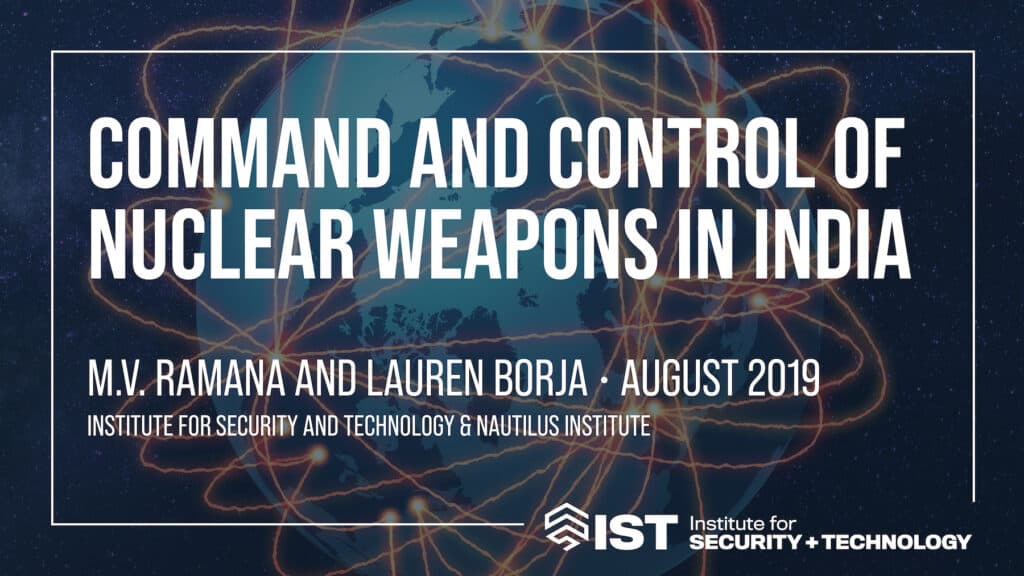
Indian strategists and policy makers have been grappling with the challenges of setting up a system for the command and control of nuclear weapons since the 1960s. Due to the extremely opaque public record regarding nuclear matters more broadly, it remains “hard to put together a comprehensive account of nuclear command and control in India.” In this essay, however, M.V. Ramana and Lauren Borja attempt to lay out what is known, concluding that Indian “nuclear weapons are said to be controlled by the Nuclear Command Authority, a two layered structure, one of which is headed by the Prime Minister. Nuclear command and control in India,” they conclude, “has been shaped by an ongoing rivalry between civilian authorities and the military.” In the tense South Asian nuclear standoff, with disagreement in the public sphere regarding even policies such as no nuclear first use, India’s approach to NC3 remains a critical issue set.
About the authors: M.V. Ramana is the Simons Chair in Disarmament, Global and Human Security with the Liu Institute for Global Issues at the School of Public Policy and Global Affairs, University of British Columbia (UBC), Vancouver. Lauren Borja is Simons Postdoctoral Research Fellow at the UBC Liu Institute for Global Issues, Vancouver.