


What does ‘strategic stability’ actually mean for the Perry-Shultz Center, and how has that definition changed since the Cold War era?
Steve Kelly: “Presidents Trump and Xi in May agreed to pursue a ‘constructive relationship of strategic stability,’ which left many wondering, “what does that mean in practice?” Born of the Cold War nuclear standoff between the United States and the Soviet Union, strategic stability described a condition in which neither superpower had an incentive to escalate a conflict into the nuclear realm. Mutually assured destruction held the peace.
That definition is no longer enough. While strategic stability remains primarily a function of deterrence among states, we argue that the conditions that make deterrence work can be shaped and eroded by technology-enabled dynamics at the societal level. AI is the ultimate example of this, as it is increasingly demonstrating the ability to enable information warfare that erodes public trust at scale, and automated cyber attacks that could hold critical infrastructure services at risk. Such effects become a matter of strategic stability when they undermine a state’s ability to mobilize and project power, thereby altering the deterrence calculus between states.
In answer to the challenges of our era, and taking inspiration from the legacies of former Defense Secretary William Perry and late Secretary of State George Shultz, IST has established this Center to shape technology’s trajectory into a force for stability, and forge common cause among states and nonstate actors against its most consequential risks.”
What lessons do you take away from the careers of Secretaries George Perry and William Shultz?
Sylvia Mishra: “The legacies of Secretary Perry and Secretary Shultz remind us to stay ahead of technological change while using diplomacy and careful decision-making to harness its benefits and manage its risks.
In 1979, Secretary Perry, then Under Secretary of Defense, received a warning in the middle of the night that Soviet missiles were headed for the United States. The warning proved false, triggered by a training tape, but the incident revealed how quickly a technical failure can become a high-stakes decision point. The lesson stayed with him: technical literacy, combined with human judgment and diplomacy, can prevent a technical failure from becoming a catastrophe.
That principle guides the work of the Perry-Shultz Center. Our AI-NC3 project develops recommendations for policymakers on integrating AI into nuclear systems safely. Our CATALINK project advances a blueprint for a multilateral nuclear crisis communications channel to help pull back from the brink. Our AI-Nuclear Policy Accelerator builds AI literacy for a cadre of mid-career nuclear weapons and national security experts. And our U.S.-China work focuses on managing AI-nuclear risks and the dynamics of the AI race, with the aim of creating conditions for strategic stability. Across these efforts, our goal is the same—we seek to harness the promise of technological progress while reducing the risk of catastrophe.”
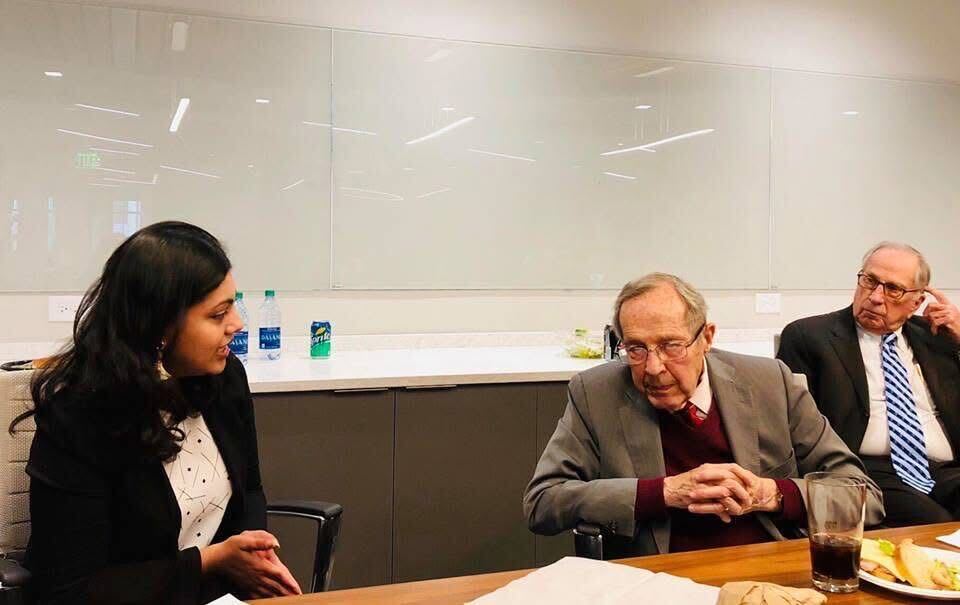
Washington DC, 2018: Sylvia Mishra briefs Secretary Perry and Senator Sam Nunn
What’s one of your biggest takeaways from your project?
Brandon Cortino: “My project is focused on the intersection of AI with nuclear command, control, and communications. It is defined by technical expertise about AI, and unclassified operational knowledge of NC3 systems. This is an incredibly niche pairing of subjects with extraordinarily few practitioners capable of discussing that overlap.
The most interesting concept I’ve learned through this project is “epistemic capture.” This refers to the idea of an AI system curating what data it shares in a way that changes our perceptions and understanding of the world around us. In simpler terms, it’s like picking up milk for a friend while on the phone with them, and you choose one specific brand without mentioning the other three varieties or the yogurt directly next to the milk. By making a choice to exclude the information about what milk brands the store has, you shape their perception of the store and their options, which modifies their decision about what milk to get without them realizing it. Now imagine that instead of milk, it’s a missile launch notification, and you see how easy it would be to make a decision with incomplete data unless you know what to look for outside the information presented by a machine while feeling extreme time burdens.”
What’s something about AI or other emerging tech that you think people consistently misunderstand?
Brandon Cortino:“When people hear about the intersection of AI and nuclear weapons, their minds might go to Skynet, the malevolent AI overlord from the Terminator film franchise, or the newest Mission Impossible movie. The reality is more complex: rather than an evil robot uprising, the biggest risk of AI integration into nuclear operations is that human beings will be more likely to cause catastrophe through unintentional nuclear escalation by over-relying on poorly integrated data streams.”
What’s a technology outside of AI that deserves more attention from people who care about global stability?
Catherine Murphy: “Counterspace capabilities deserve more attention in strategic stability discussions. Nuclear-armed states rely on satellites for command & control and crisis communications, and commercial and military space systems are increasingly entangled. As a result, an attack on one satellite could hit another system, triggering unintended escalation. Anti-satellite (ASAT) weapons, high-powered lasers and microwaves, and jamming and spoofing can sever or corrupt the assets that leaders need to maintain continuous operations and communications. Few international rules govern interference with space assets, leaving multiple possible escalation pathways towards direct conflict between nuclear powers.”
Larissa Alves Lozano: “Additive Manufacturing (AM), or 3D printing, is one technology that I think is underrated, and it has tremendous proliferation implications. Printing methods and filament materials are constantly evolving and have high dual-use capabilities. “Living” biogels used in medicine, for example, pose biological weapon concerns. High-durability metal alloys and ceramics can be used to make drones, missiles, and even nuclear warhead reentry vehicles. While AM streamlines manufacturing at a fraction of the cost, it lacks regulations. From instantly-shareable digital blueprints to untraceable printed components, AM blurs the line between tangible and intangible export controlled goods while lowering the barrier of access to restricted equipment for non-state actors and rogue states faced with sanctions. As a result, this technology has the potential to further accelerate global conventional and nuclear arms modernization.”
Which emerging technology keeps you up at night when you think about deterrence? Which one are you more optimistic about?
Sylvia Mishra: “I am optimistic about AI’s potential to improve intelligence, situational awareness, and our understanding of adversaries’ actions and intentions. But one aspect of AI applications to military platforms that gives me pause is the future of undersea warfare. As AI enables increasingly networked and capable underwater drones, their potential to detect, track, and hunt nuclear-armed submarines could have significant implications for second-strike capabilities and, ultimately, strategic stability. I often find myself thinking about how these developments could reshape the foundations of nuclear deterrence, particularly if the survivability of nuclear submarines can no longer be taken for granted.”
As you know, the Center’s color is purple, and it wasn’t just random. Why purple?
Steve Kelly: “The purple is a deliberate synthesis of the two traditions its namesakes embodied, and the two forces the Center exists to reconcile. William Perry and George Shultz served presidents of different parties and stood on opposite sides of the strategic-stability equation: one the steward of deterrence and hard power, the other the architect of diplomacy and trust-building. Purple is what you get when the red of nuclear danger meets the blue of diplomacy and when traditions from different sides of the American political system work productively across the aisle.
The Center’s mark carries that synthesis forward. It is a reminder that our work lives in the space between hard power and diplomacy, between competing parties, and between competing nations. That space is where Perry and Shultz did their most consequential work. It is where we intend to do ours.”