Preventing the onset or escalation of conflict by building a resilient global communications system.
When Every Second Counts
Why the world needs a new last-resort nuclear hotline like CATALINK
The Problem
Today’s nuclear command control and communications systems (NC3) rely on both legacy and modern technologies that are increasingly vulnerable to rapidly emerging, disruptive capabilities. This fact compounds what is already an untenable reality of NC3 systems: the communications links that underwrite their credibility are the first targets in any escalating kinetic conflict. Despite these facts, if and when NC3 systems fail under stress, leaders must still be able to communicate to prevent large-scale conflagration.
The Solution
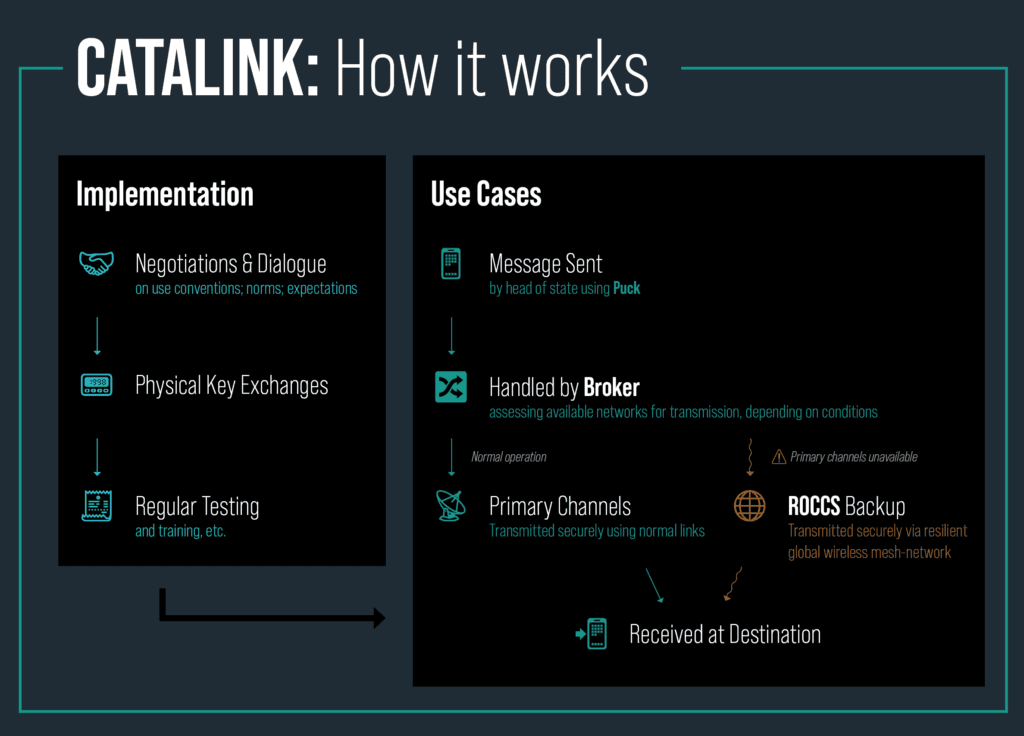
An internationally-driven, secure, resilient communications solution that has the potential to avert catastrophes amidst rising tensions between adversaries: The CATALINK system.
The system consists of an endpoint device called a Puck that rides on a global mesh-network called the ROCCS. The CATALINK would build on the “hotline” model of previous generations, and rely on internationally driven open-source technologies to maximize user integrity and trust. It would exploit redundant transmission capabilities to ensure that multiple parties could connect under extreme conditions, including loss of power and the absence of cellular and/or internet connectivity. Endpoint devices would be designed for durability, availability, and ease of use, enabling parties to immediately connect with confidence amid crises. These endpoint devices would also be secure: the firmware, software, and hardware would all meet cutting edge world class requirements for security. Looking for examples of how to build international consensus around this concept, we took inspiration from the process that led to the creation of the National Institute of Standard and Technology Advanced Encryption Standard (NIST AES). To ensure the integrity and validity of the technical solution, we are building a community of passionate global citizens from varying professional backgrounds.
The Puck: A simple, secure and robust device meant for dedicated communication between global leaders and officials during a nuclear crisis or other high-stakes events like disaster response. The Puck project consists of designing, developing and supplying the PUCK Platform board based on open-source platform design, to include consideration and agreement for applicable hardware (RISC-V), firmware (OREBOOT) and software.
ROCCS: Resilient Omni Frequency Crisis Communications System based in a global mesh network. ROCCS is a permanently active network that utilizes multiple networks and channels/wavelengths to ensure reliable relays of Puck messages and is one of a variety of redundant networks on which the Puck messages may ride depending on availability, the threat environment, and the type of message sent. Between the ROCCS and the Puck exists a “Broker” interface, which determines the path of the Puck message throughout the desired network. The Broker will switch networks as needed – including between satellites, commercial networks, fiber-optic lines, and high-frequency or low-frequency radio bands – and will switch to the final resilient mesh network of the ROCCS if/when all other options fail or are compromised. ROCCS recognizes and works to integrate the need for leaders to communicate in a crisis where all conditions are degraded by conflict including the effects of nuclear weapons on the atmosphere, cyber attacks, electromagnetic jamming, and perhaps even biological attacks.