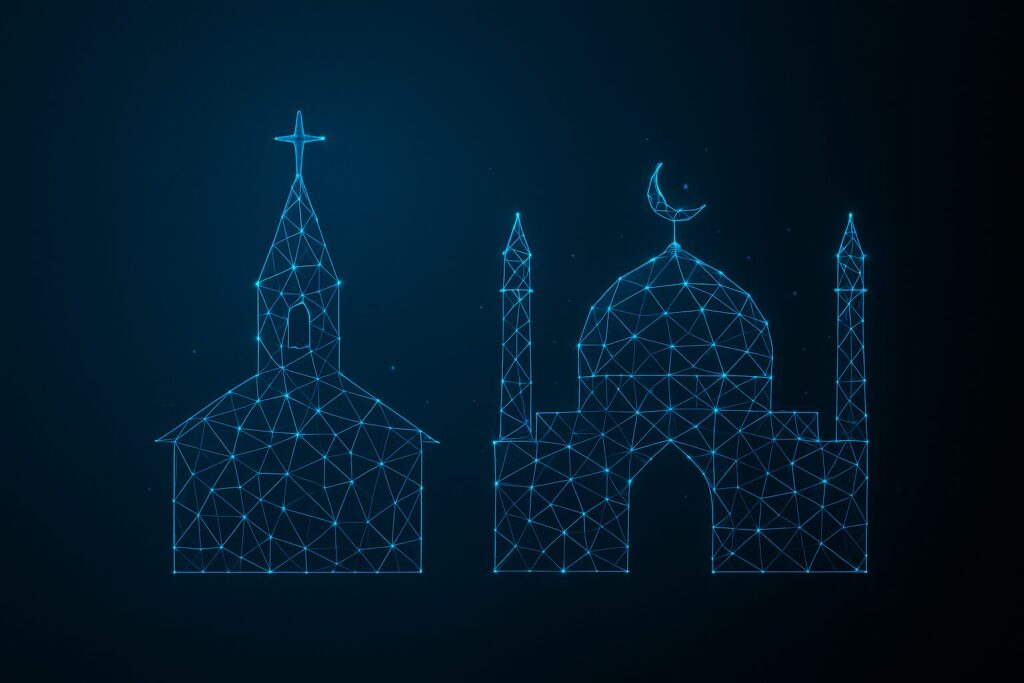
Last week, the two of us made the long haul from California to DC to join a small gathering of people engaged at the intersection of religion and artificial intelligence. Convened by the team leading the Future of Life Institute’s Traditional Religions on AI Futures Project, we broke bread with computer scientists, religious leaders from multiple faiths, technology policy wonks, and experts in related fields like AI and policing, neuroscience, and platform governance protocols.
The impetus to convene focused around Magnifica Humanitas, the Vatican encyclical that articulates what Catholic Social Teaching has to say about beneficial versus harmful ways that humans can develop and utilize artificial intelligence. This encyclical is the latest in a growing list of statements by different religious leaders focused on how to protect what is uniquely human, while still benefitting from reasonably deployed emerging technologies and artificial intelligence. For those of us at the gathering, the encyclical also served as a catalyst for a dialogue about how to educate, shape, and engage with communities across the United States on the use of artificial intelligence. While not all of our perspectives were aligned, we shared a common goal: seeking to shape the technology to foster human flourishing, rather than allowing the technology to shape humans in unintended and harmful ways.
One particularly insightful area of discussion focused on how AI is shaping the experience of clerics and religious leaders shepherding congregations. Multiple participants spoke about how faith leaders are balancing beneficial uses of AI in their tasks of ministry versus uses that they believe could create distance between clerics and congregations. One thing we heard was the idea that loneliness, alongside the temptation to rely on artificial sources of companionship, comes for pastors and faith leaders as well as parishioners. For both of us – Elizabeth as an active member of a local church and Fatima as a member of a Muslim community – the gathering brought home how, across different traditions, faith leaders face strikingly similar pressures. Above all, they share the need for support during this increasingly techno-immersive time in human history.
The first day of the event centered on the people gathered in the room, while the second turned to the text that had drawn us together. We spent it in close conversation about Magnifica Humanitas itself, not only what it means within the Catholic tradition, but how communities beyond it might read it, borrow from it, and respectfully contest its assumptions. We repeatedly came back to the encyclical’s insistence that AI reaches well beyond our work and our information ecosystems into the most ordinary and the most sacred corners of life: how we spend an idle hour, how we pray, how we grieve, and how we care for one another.
In the discussion, was the encyclical’s call for “digital sobriety”: a caution that platforms engineered to capture our attention can quietly wear away our interior freedom, and an invitation to practice restraint as a way of guarding it. We were struck by how legible that idea is across traditions. For Fatima, it echoes Islamic practices of intention and restraint; for Elizabeth, it brings to mind the Christian understanding of “guarding your mind” and focusing on what is good. Framed that way, digital sobriety is less a rejection of technology than a reclaiming of the self, not for its own sake, but for more presence, more freedom, and more room to attend to God and to one another. It gave us a shared vocabulary to draw from as we build open access curricula specifically tailored to evangelical Christians and American Muslims in Southern California and the San Francisco Bay area through our Religious Voices and Responsible AI initiative.
However, that framing also has its limits – it poses AI use as a personal choice, rather than as a societal challenge requiring national and global policy choices. Digital sobriety also needs to be held in tandem with the encyclical’s emphasis on solidarity and its push for decisions about the structure and use of AI to be made by communities, rather than individuals and corporations.
As the two days drew to a close, we left the gathering with a shared sense of purpose, confident that thoughtful, well-intentioned people are actively working to bring fresh perspectives into the conversation around AI’s role in our society. For our part, over the next few months, we will be taking the energy from these discussions to our pilots of the religion and AI curricula we are developing in collaboration with AI and Faith.
To learn more about what other organizations are doing in this space, check out other ongoing efforts: Sinai and Synapses, The Gospel Coalition’s AI Christian Benchmark, The Aegix Institute’s AI Governance Academy, and Santa Clara University’s Markkula Center for Applied Ethics’ efforts on Technology Ethics. And stay tuned: this November, we will publish our own open-access curriculum focused on AI issues specifically tailored to use by evangelical Christians and American Muslims. Our intent is that these materials are part of an ongoing effort by people of good will to follow Pope Leo’s encouragement in paragraph 238: “Let us invest in education, beginning with ourselves!”