Skip to content
Sign Up for Our Newsletter
About
Close About
Open About
About the Institute for Security and Technology
Our Team
Board Of Directors
Careers
Contact Us
Featured Events
Cyber Policy Awards
Critical Effect DC
Projects
Close Projects
Open Projects
AI and NC3
Pioneering action-oriented efforts to explore how advanced AI capabilities will be integrated into nuclear command, control, and communications
AI Antitrust and National Security
Exploring how to more effectively account for national security considerations in AI antitrust cases while respecting precedent, scope, and the core principles of antitrust law
AI Risk Reduction Initiative
Assessing the emerging risks and opportunities of AI foundation models and developing risk reduction strategies
AI Chip Export Control Initiative
Safeguarding U.S. national competitiveness by closing critical compliance and enforcement gaps
AI Risk Barometer
Measuring national security professionals’ perceptions of AI futures through a technically-informed survey
CATALINK
Preventing the onset or escalation of conflict by building a resilient global communications system
Energy FIRST
Powering U.S. and allied security & prosperity through a resilient energy future
Ransomware Task Force (RTF)
Combating the ransomware threat with a cross-sector approach
Religious Voices and Responsible AI
Engaging religious communities on safe and beneficial AI
SL5 Task Force
Strengthening AI security through a multistakeholder approach
UnDisruptable27
Driving more resilient lifeline critical infrastructure for our communities
All Projects
» Explore all of IST's projects, past and current
Focus Areas
Future of Digital Security
Geopolitics of Technology
Innovation and Catastrophic Risk
Events
Insights
Contact
Search
Donate
Archive
escalation
Report
Securing the Signal: Mitigation Strategies to Strengthen Crisis Communication Channels
As global norms are challenged and emerging technologies accelerate, crisis communication systems between nuclear-armed states face urgent new threats. This report identifies four critical scenarios and outlines a matched set of mitigation strategies designed to reinforce the reliability of crisis communications in high-stakes environments.
CATALINK
,
cold war
,
crisis communications
,
electromagnetic pulse
,
EMP
,
escalation
,
miscalculation
,
nuclear
May 28, 2025
Event
September 9, 2024 3:00 pm
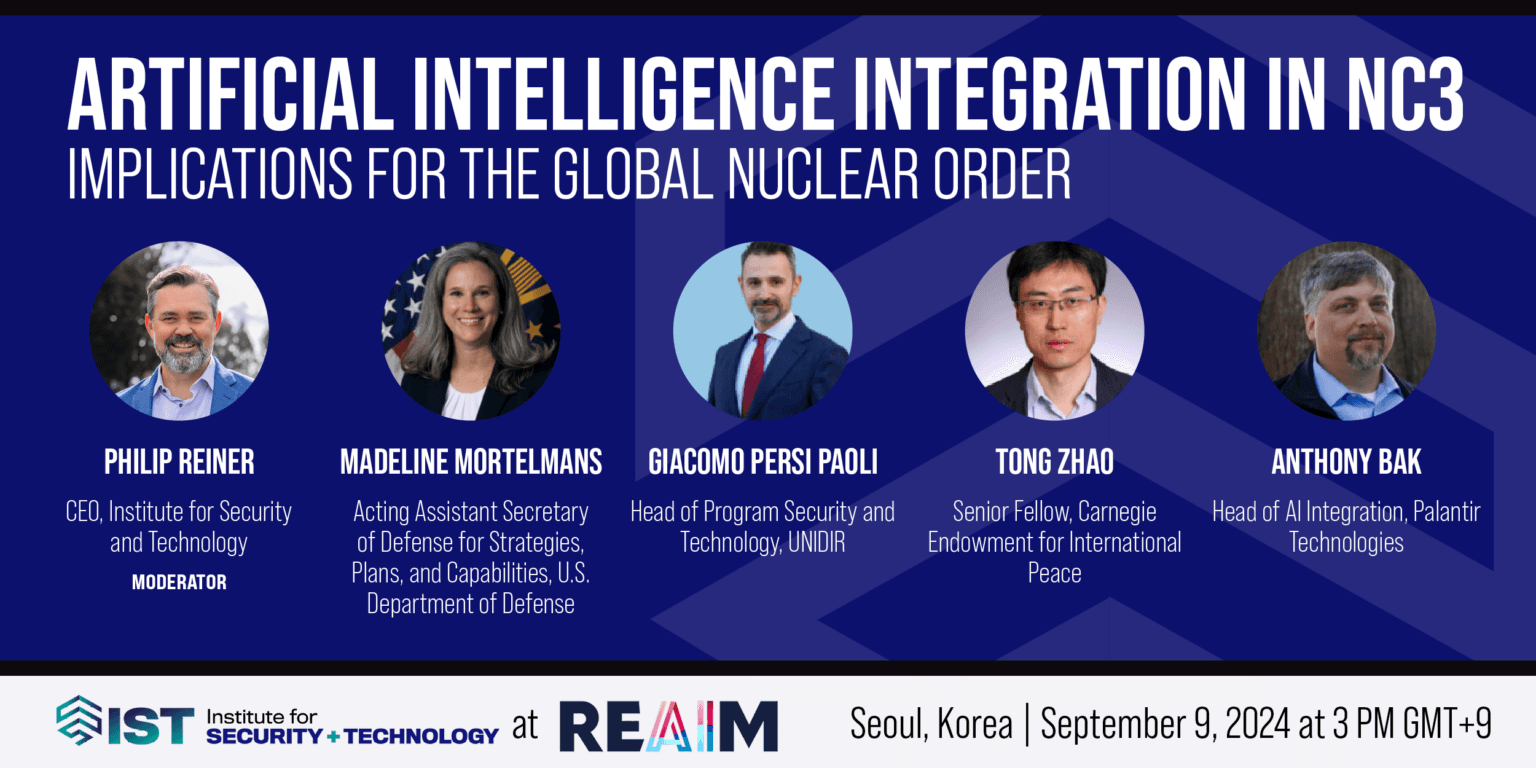
Artificial Intelligence Integration in NC3: Implications for the Global Nuclear Order
IST hosted a side event at the 2024 REAIM Summit in Seoul, South Korea on the intersection of AI and nuclear weapons and its implications for nuclear deterrence and strategic stability.
AI
,
artificial intelligence
,
decision making
,
deterrence
,
escalation
,
miscommunication
,
NC3
,
nuclear
,
strategic stability
September 9, 2024
Report
Hotline Between Two Koreas: Status, Limitations and Future Tasks
In this paper, Moon Chung-in and Boo Seung-Chan provide historical context on the hotlines linking South and North Korea and point to the lessons that can be learned from the decades-long effort.
CATALINK
,
communication
,
communication link
,
crisis
,
crisis management
,
escalation
,
history
,
hotlines
,
Innovation and Catastrophic Risk
,
NC3
,
nuclear
,
nuclear security
,
nuclear weapon
,
nuclear weapon states
,
nuclear weapons
,
nuclear-use
,
secure communications
December 17, 2020
Report
Building Communications Norms Across Nuclear C2
Dr. Salma Shaheen stresses the importance of establishing new norms, constructing new practices, and securing reliant communications between nuclear-armed states before a potential crisis. Shaheen reaffirms the need for a direct communication link between global leaders to facilitate quick and efficient communications between nuclear-armed states — a capability she cites as essential for escalation control and nuclear weapons reduction, with a direct impact on crisis aversion and thus global security.
CATALINK
,
communication
,
control
,
crisis
,
crisis management
,
escalation
,
history
,
hotlines
,
NC3
,
nuclear
,
nuclear security
,
nuclear weapon
,
nuclear-use
,
secure communications
November 24, 2020
Report
Nuclear Hotlines: Origins, Evolution, Applications
Dr. Steven E. Miller gives an overview of experiences to-date with nuclear hotlines. He reviews the history of the US-Russia hotline, describes the ways that hotlines can be used or misused, and charts how the hotline concept has evolved and propagated to help states manage international crises. Hotlines are important, if imperfect, tools for avoiding nuclear conflict.
CATALINK
,
crisis
,
crisis management
,
de-escalation
,
escalation
,
history
,
hotlines
,
NC3
,
nuclear
,
nuclear security
,
nuclear weapon
,
nuclear-use
,
secure communications
October 28, 2020
Report
Communication Disruption Attacks on NC3
In an essay out of the workshop "Last Chance: Communicating at the Nuclear Brink," Paul Bracken argues, "in a nuclear world we should be careful about attacking enemy communications because doing so leads to greater risks of uncontrolled escalation. The worst possible situation is the one the United States is now in, that is, to not be clear in our own minds about what we are doing when it comes to disrupting communications.”
CATALINK
,
communication
,
communication attacks
,
electromagnetic pulse
,
electronic warfare
,
escalation
,
military
,
NC3
,
nuclear
,
red line
,
retaliation
,
strike
,
target
,
targeting
,
United States
,
vulnerability
May 28, 2020
Report
Cyber Operations and Nuclear Weapons
In Cyber Operations and Nuclear Weapons, Jon Lindsay argues that "offensive cyber operations targeting NC3 introduce a number of under-appreciated risks of organizational breakdown, decision making confusion, and rational miscalculation in a nuclear crisis.”
accidental launch
,
arms control
,
attack vector
,
complexity
,
computer
,
control
,
counterattack
,
counterintelligence
,
countermeasure
,
crisis
,
crytographic
,
cyber
,
digital
,
electronic warfare
,
escalation
,
NC3
,
reconnaissance
,
redundant
,
retaliation
,
software
,
stability
,
Stuxnet
,
supercomputer
June 20, 2019
Report
Nuclear Command, Control, and Communications Systems of the People’s Republic of China
Fiona Cunningham describes the origins of China’s NC3 system and its primary role in supporting China’s land-based missile force. She outlines recent developments including mobility, “informatization” and automation of parts of the NC3 system, pending deployment of nuclear missile submarines, early warning systems, evolving organizational structure, and cultural factors that shape China’s NC3 system and its orientation towards negative versus positive control.
arms race
,
China
,
crisis instability
,
emergency
,
escalation
,
modernization
,
NC3
,
nuclear
,
red line
,
stability
July 18, 2019
Report
NC3 and Crisis Instability: Growing Dangers in the 21st Century
Daryl Press focuses on the growing threats to nuclear command and control and communication (NC3) systems around the world and the links between vulnerable NC3 and strategic instability due to the risky steps that nuclear weapons states may adopt to protect their arsenals during crises or wars.
accident
,
accuracy revolution
,
air defense
,
alert level
,
arms race
,
artificial intelligence
,
cold war
,
conventional weapon
,
crisis instability
,
data
,
decision-making
,
deterrence
,
escalation
,
force planning
,
modernization
,
NATO
,
NC3
,
nuclear
,
preemptive strike
,
stability
,
survivability
October 17, 2019
Search
Search