Skip to content
Sign Up for Our Newsletter
About
Close About
Open About
About the Institute for Security and Technology
Our Team
Board Of Directors
Careers
Contact Us
Featured Events
Cyber Policy Awards
Critical Effect DC
Projects
Close Projects
Open Projects
AI and NC3
Pioneering action-oriented efforts to explore how advanced AI capabilities will be integrated into nuclear command, control, and communications
AI Antitrust and National Security
Exploring how to more effectively account for national security considerations in AI antitrust cases while respecting precedent, scope, and the core principles of antitrust law
AI Risk Reduction Initiative
Assessing the emerging risks and opportunities of AI foundation models and developing risk reduction strategies
AI Chip Export Control Initiative
Safeguarding U.S. national competitiveness by closing critical compliance and enforcement gaps
AI Risk Barometer
Measuring national security professionals’ perceptions of AI futures through a technically-informed survey
CATALINK
Preventing the onset or escalation of conflict by building a resilient global communications system
Energy FIRST
Powering U.S. and allied security & prosperity through a resilient energy future
Ransomware Task Force (RTF)
Combating the ransomware threat with a cross-sector approach
Religious Voices and Responsible AI
Engaging religious communities on safe and beneficial AI
SL5 Task Force
Strengthening AI security through a multistakeholder approach
UnDisruptable27
Driving more resilient lifeline critical infrastructure for our communities
All Projects
» Explore all of IST's projects, past and current
Focus Areas
Future of Digital Security
Geopolitics of Technology
Innovation and Catastrophic Risk
Events
Insights
Contact
Search
Donate
Archive
2022
Report
Towards a Stronger Ukrainian Media Ecosystem
As Russian troops and military equipment surged on the border with Ukraine in 2021, IST used data gathered by VAST-OSINT Technologies to identify emerging narratives in Russian and Ukrainian across Ukraine’s media ecosystem. IST was able to pinpoint the origins of Russian disinformation narratives before they became mainstream and to provide timely insights to counter those narratives.
disinformation
,
media ecosystem
,
Russia
,
Ukraine
December 14, 2022
In the News
,
Op-ed
Pentagon’s Office of Strategic Capital must win over Silicon Valley
In December, the United States Department of Defense established the Office of Strategic Capital to build out the U.S.’s strategic advantage in technology and industry by partnering with private capital. In an op-ed for Defense News, IST’s Leah Walker and Alexa W. caution that the office’s success hinges on acceptance in Silicon Valley and innovation hubs across the country.
DOD
,
innovation ecosystem
,
Office of Strategic Capital
December 13, 2022
Fact Sheet
DOD Establishes the Office of Strategic Capital
On Thursday, December 1, Secretary of Defense Lloyd Austin established the Office of Strategic Capital (OSC), defining it as an “organization that will help build an enduring technological advantage by partnering with private capital providers.”
DOD
,
innovation ecosystem
,
Office of Strategic Capital
December 7, 2022
Report
To the Point of Failure: Identifying Failure Points for Crisis Communications Systems
Crisis communication systems can fail in a variety of ways. To shed light on the many different failures that degrade and undermine such systems, this report identifies four categories of pathways to failure: operational failures, adversarial failures, accidental failures and institutional failures. Each category is made up of specific types of failures, investigated in further detail in the following sections of this report.
NC3
,
nuclear crisis communications
,
nuclear risk reduction
,
points of failure
November 30, 2022
Report
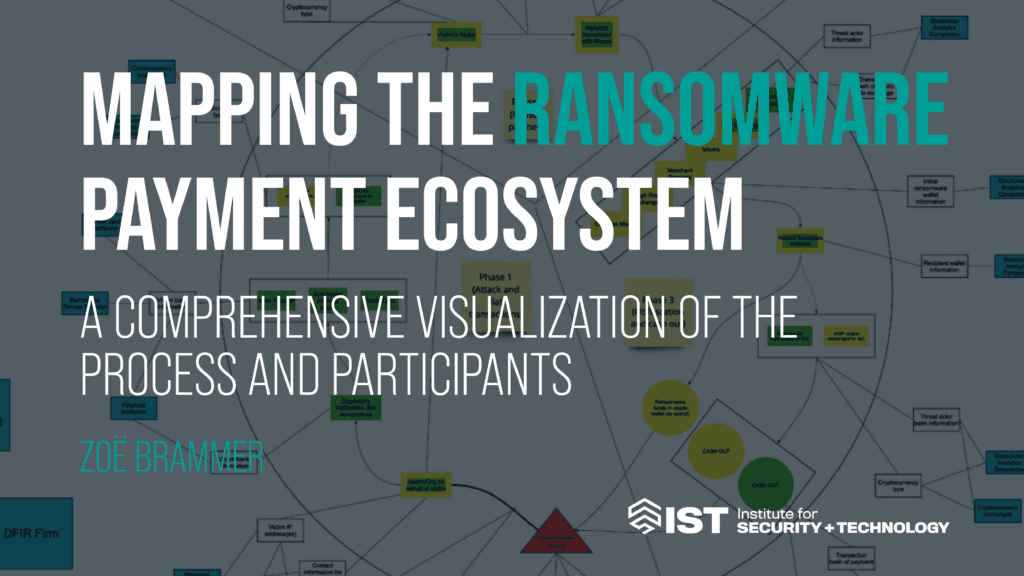
Mapping the Ransomware Payment Ecosystem: A Comprehensive Visualization of the Process and Participants
Central to our ability to mitigate the threat of ransomware is the development of a common understanding of the actors, stakeholders, processes, and information, both required for and produced during the ransomware payment process. Yet, when we began this work, such a picture did not exist. We undertook this effort to fill that gap.
mapping
,
ransom payments
,
Ransomware
,
visualization
November 15, 2022
Report
Plan maestro de defensa contra los programas de secuestro
En respuesta a la acción 3.1.1 del Informe del Grupo de Trabajo sobre Programas de Secuestro, en la cual se exhorta a las organizaciones de ciberseguridad a establecer un marco claro y accionable para la mitigación, la respuesta y la recuperación ante programas de secuestro, el Grupo de Trabajo encargado de elaborar un plan de defensa contra los programas de secuestro formuló un plan maestro que abarca un subconjunto de salvaguardias esenciales de ciberhigiene seleccionadas de los controles críticos de seguridad del Centro para la Seguridad de Internet (CIS Controls®) v8.
Blueprint for Ransomware Defense
,
cyber attacks
,
defense
,
Future of Digital Security
,
Ransomware
,
RTF
November 10, 2022
In the News
,
Op-ed
Democracy Gone Digital: The Election Season Online
In an op-ed for Tech Policy Press, Zoë Brammer and Philip Reiner sound the alarm based on our Digital Cognition and Democracy Initiative (DCDI) research. We need to help voters grapple with information overload and unnaturally immersive experience provoked by digital tools, they urge.
DCDI
,
democracy
,
digital cognition
,
election manipulation
November 7, 2022
Report
Cyber Incident Reporting Framework
The Framework lays out a set of model reporting formats the Cybersecurity and Infrastructure Security Agency (CISA) could use as the foundation for the cyber incident reporting.
CIRCIA
,
cyber
,
cybersecurity
,
incident reporting
,
Ransomware
November 3, 2022
Op-ed
Cyber incident reporting isn’t the problem — ignorance is
In an op-ed for The Hill, IST's Chief Strategy Officer Megan Stifel and Cyber Threat Alliance's President & CEO Michael Daniel make the case for reporting cyber incidents.
CIRCIA
,
CISA
,
incident reporting
,
Ransomware
November 2, 2022
Report
Digital Tools, Cognition, and Democracy: A Review of the Literature
This literature review supports a series examining the effects digital technologies have on the following cognitive processes: "Memory," "Attention," and "Reasoning." The broader report series includes three additional papers looking at some of the society-level cognitive and democratic impacts of technology, titled: "Modulating Trust," "Shortcutting Critical Thinking," and "Exploiting Emotions."
attention
,
cognition
,
DCDI
,
democracy
,
emotions
,
Geopolitics of Technology
,
memory
,
reasoning
,
social
October 27, 2022
Report
Reasoning: How digital technologies influence decision making and judgment
This report provides a working definition of reasoning, narrowing the scope of the discussion to judgment and decision making. We identify three aspects of digital technology that exert significant impacts on reasoning: user experience design, gamification, and search engines. Examples include social media platforms, gamified platforms like Robinhood, and search engines like Google and Wikipedia. Key findings include:
cognition
,
DCDI
,
decision making
,
democracy
,
gamification
,
Geopolitics of Technology
,
judgment
,
reasoning
,
search engines
,
user experience design
October 27, 2022
Report
Attention: How digital technologies influence what we notice, what we focus on, and how we learn
This report examines the impact that technology has on the cognitive function of attention. It provides a working definition of attention within a cognitive science context, including the distinction between overt and covert attention. It summarizes findings that elucidate how attention is affected by the passive and active consumption of technology.
attention
,
cognition
,
critical thinking
,
DCDI
,
democracy
,
emotions
,
gamification
,
Geopolitics of Technology
,
memory
,
reasoning
October 27, 2022
Report
Memory: How digital technologies influence cognitive information storage
Memory is foundational to cognition. It enables individuals to operate with certain assumptions about truth based on prior validated beliefs. Memory informs individual decision making, reasoning, and problem solving. There are also significant societal implications rooted in memory function. Individual memories, collectively and cumulatively, inform the development of “national memory,” which in turn influences “the construction of a democratic culture and collective identity.” This report provides a working definition of memory and focuses especially on long-term memory.
bias
,
cognition
,
DCDI
,
democracy
,
Geopolitics of Technology
,
GPS effect
,
manipulation
,
memory
,
trust
October 27, 2022
Report
Shortcutting Critical Thinking
The scale, accuracy, and speed of digital technologies make them particularly effective at activating the very emotions that influence and undermine critical thinking. Not only do digital technologies have the ability to inflame those emotions, but they often are designed to do so, as those very emotions drive engagement, use, and consumer spending.
attention
,
cognition
,
critical thinking
,
DCDI
,
democracy
,
emotions
,
Geopolitics of Technology
,
reasoning
October 27, 2022
Report
Modulating Trust
Social trust – trust in other people and institutions – is critical to the DCDI problem set. But trust is not always beneficial. Although trust in technology can facilitate economic transactions, it can also diminish our capacity for skepticism. Consumers tend to prefer to use technologies that they trust, and sellers and developers of technology find more success when there is more trust in their systems. Yet trust placed too freely in technologies can also generate vulnerabilities for those same consumers–to identity theft, to addiction, to misinformation, and to fraud.
attention
,
cognition
,
DCDI
,
democracy
,
fraud
,
Geopolitics of Technology
,
misinformation
,
social trust
,
trust
October 27, 2022
Report
Exploiting Emotions
Digital systems exploit and manipulate emotions by design. Emotions prompt people to use digital tools, engage with content, products, and services, respond to advertisements, stay on or return to digital platforms, and even take action offline as a result of online experience. The design of the digital environment, especially its visual nature, also heightens user emotions, often creating an addictive cycle. Because emotions affect how we process, engage with, and often act upon information, they play a central role in the relationship between digital tools and democracy.
addictive
,
attention
,
cognition
,
DCDI
,
democracy
,
Geopolitics of Technology
,
memory
,
networks
,
reasoning
,
social
October 27, 2022
Previous
Page
1
Page
2
Page
3
Next
Search
Search
MENU
HOME PAGE
About CATALINK
CATALINK Frequently Asked Questions
The CATALINK Brief
Insights
Events
Analysis
Podcasts
Why crisis communications?
Our Team
GET IN TOUCH
Email:
[email protected]
Send us a message:
Contact
JOIN THE CATALINK MAILING LIST
First Name
Last Name
Organization
Email
Subscribe