


Earlier this month at the AI+ Expo hosted by the Special Competitive Studies Project (SCSP), the Institute for Security and Technology (IST) convened a panel on one of the most consequential questions shaping technology and national security today: how is China building AI power, and what does the United States still misunderstand about the systems and actors driving it?
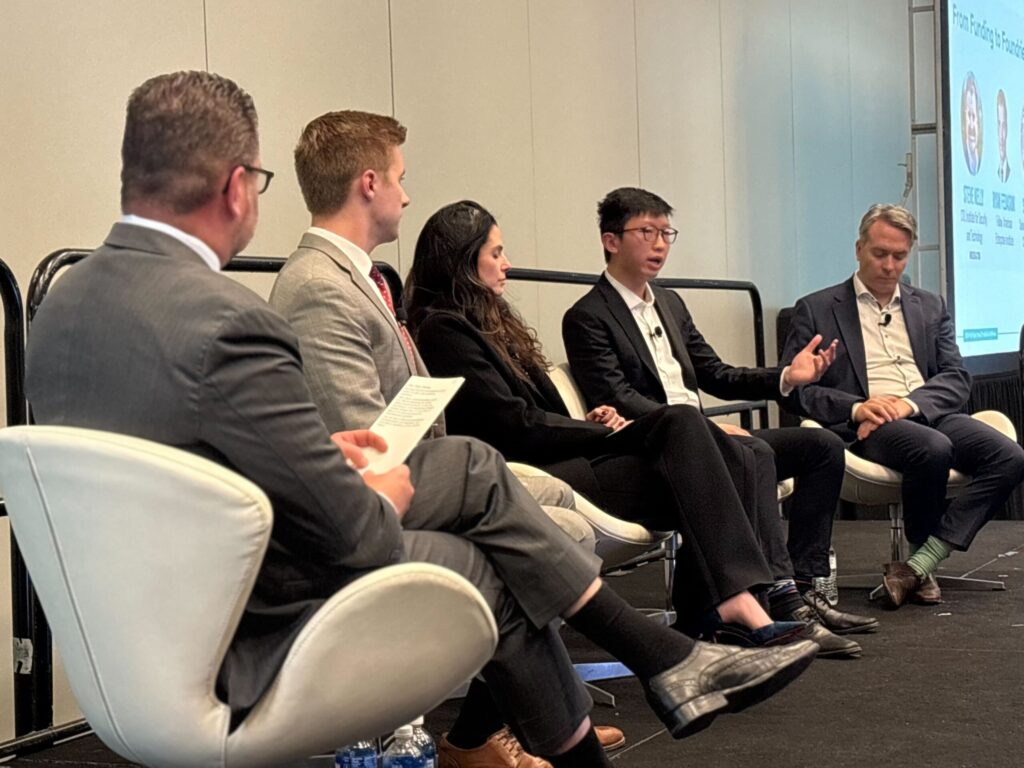
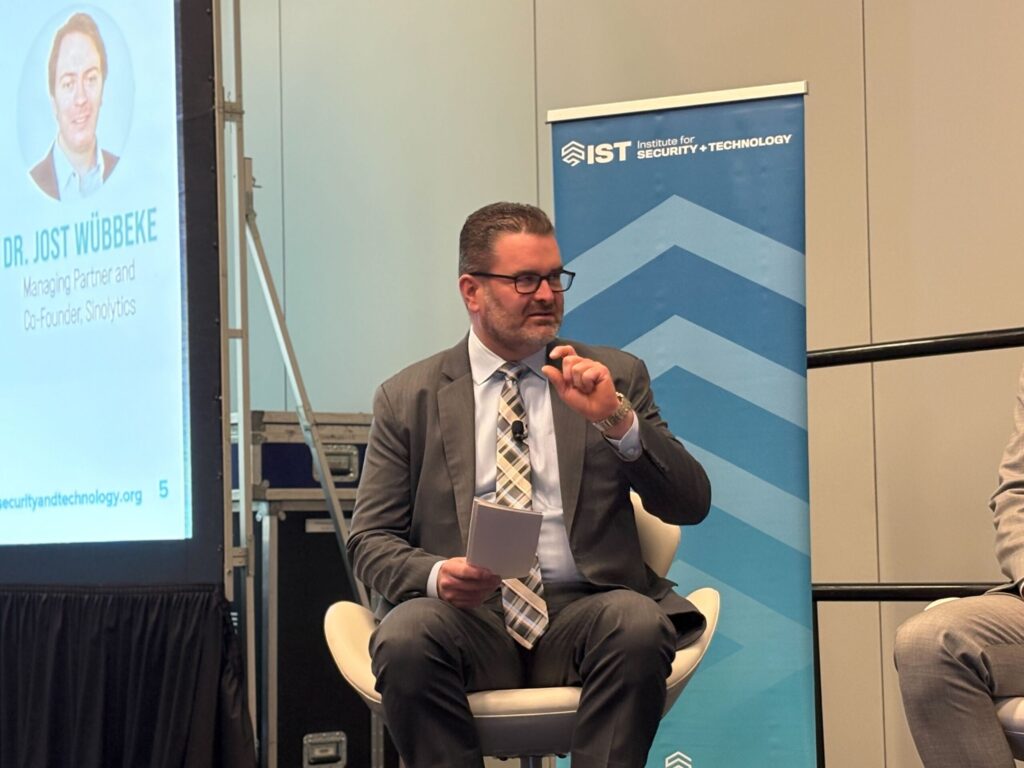
The discussion, titled “From Funding to Foundries: How China Builds AI Power,” brought together expert China watchers from across government, industry, academia, and policy research. Moderated by IST’s Steve Kelly, the panel featured American Enterprise Institute Fellow Ryan Fedasiuk, Yale University Paul Tsai China Center Senior Fellow Samm Sachs, The Jamestown Foundation Research Fellow Sunny Cheung, and Sinolytics Managing Partner and Co-Founder Dr. Jost Wübbeke. We opened the session with a scene-setter briefing drawn from two IST initiatives: the Strategic Balancing Initiative, which examines alignment between U.S. public- and private-sector approaches totechnological competition with China, and the AI Chip Export Control Initiative, which studies the effectiveness and strategic implications of semiconductor export controls.
Many debates in Washington over China’s technology ecosystem often reduce its systems, actors, and intentions to a monolith, leaving discussions trapped between two simplistic narratives. In one, China is portrayed as a seamlessly coordinated techno-authoritarian state executing a centralized master plan. In the other, it is dismissed as an inefficient, subsidy-dependent imitator incapable of competing without stolen intellectual property and Western technology inputs. Neither framing adequately captures reality. As our panelists described, China’s system can be simultaneously fragmented and strategically directed, innovative and inefficient, and adaptive yet constrained.
Much of IST’s work in this space aims to move beyond these binaries toward a more precise account of China’s innovation ecosystem to assess where strengths are emerging, where its vulnerabilities remain, and how the United States should calibrate its strategy accordingly. The panel structured its discussion around four premises:
- China’s AI ecosystem is not centrally planned but operates through structured competition among firms, localities, and labs.
- China’s comparative strength lies less in frontier model breakthroughs than in diffusion and system-level scaling across sectors.
- U.S. export controls are reshaping, not halting, Chinese AI development.
- The build-out of the full technology stack matters more for China’s long-term position than dominance in any single layer.
Structured Competition, Not Central Planning
One of the clearest themes that emerged from the discussion was the need for a more textured understanding of how China’s ecosystem actually operates. Rather than strictly functioning through top-down coordination, panelists described a layered ecosystem in which Beijing sets a strategic direction and channels significant resources into priority sectors, particularly in semiconductor fabrication, compute infrastructure, and industrial AI deployment, as seen in various iterations of China’s Five Year Plans. Meanwhile, much of the actual experimentation and competition occurs among firms, provincial governments, and research institutions. National champions coexist with a dense ecosystem of startups vying for capital, talent, market share, and government contracts, in ways that resemble the free market competition that exists in the United States.
This structure produces both significant strengths and inefficiencies. State backing enables long investment horizons and large-scale capital deployment in ways the U.S. financing system often struggles to replicate. This is particularly true in hardware-intensive sectors where returns may take years to materialize, a gap IST examined in detail in our recent report. But competition among local governments and firms often generates redundancy, overcapacity, and fragmented implementation. The panel emphasized that these inefficiencies are not necessarily viewed in Beijing as signs of failure, but in many cases are tolerated as the cost of maintaining a high baseline rate of experimentation and accelerating capability development.
The discussion also highlighted the continued relevance of military-civil fusion and politically aligned research agendas, including what some panelists described as the “patriotic specialization” of certain companies and firms operating in strategically important sectors.
Diffusion and System Integration as Strategic Strength
Panelists argued that China’s AI strategy is not centered solely on producing the world’s most advanced frontier model. Instead, a major focus has been integrating AI across sectors, including manufacturing, healthcare, biotechnology, logistics, and financial services. State-affiliated labs, local governments, and national champions are often tasked with deploying AI into real operational environments at scale. In this view, competitive advantage comes not only from model capabilities, but from how effectively AI is absorbed into the broader economy.
As highlighted in the work of several experts, diffusion can itself be understood as a distinct dimension of technological and economic competition, one that measures how widely and effectively AI capabilities are adopted across firms, sectors, and institutions. In other words, an alternative theory of AI competition posits that the country that captures the largest productivity, industrial, and military gains from AI deployment may secure greater long-term advantage than the country that produces the single most advanced system. And as one panelist noted during the discussion, China’s approach is increasingly “whole-of-nation” in character, linking industrial policy, infrastructure buildout, financing mechanisms, and deployment incentives across multiple layers of government and industry.
In another example, panelists pointed to China’s increasing emphasis on embodied AI and robotics, including priorities outlined in the country’s 15th Five-Year Plan, as areas where its manufacturing base and supply chain could create structural advantages over time. Beyond domestic deployment, the discussion also highlighted China’s broader push to shape AI adoption, infrastructure, and technological standards in third markets through an expanding governance strategy.
Export Controls and China’s Adaptation
Rather than treating export controls as a simple question of “working” or “failing,” panelists framed them as part of a longer-term contest over technological adaptation. U.S. restrictions on advanced AI chips have imposed meaningful constraints on China’s access to leading-edge compute and helped preserve a U.S. advantage at the frontier. But, as the panelists raised during the discussion, experts also caution that they have accelerated Chinese investment into domestic semiconductor design, packaging, software optimization, and alternative compute pathways.
The discussion also emphasized that China’s response is far from uniform. State-owned enterprises, startups, and frontier AI companies face different incentives and levels of dependence on Western technology; some remain reliant on U.S. inputs, while others move aggressively toward domestic substitutes. Panelists discussed whether the export controls issue was calibrated against a realistic understanding of how Chinese firms, supply chains, and institutions adapt over time, particularly as export control policies intersect with China’s economic statecraft and its own restrictions on rare earth elements.
Recommendations for U.S. Policy
The panel took place just days before President Trump’s state visit to Beijing, where AI, export controls, and the broader technology relationship featured alongside trade tensions, Taiwan, and the impact of the Iran war on the bilateral relationship. The summit produced limited movement on technology policy, with no formal developments on the sale of Nvidia H200 chips to Chinese customers, a mere preview of future discussions on frontier AIguardrails, and a parallel signal from Beijing—through its decision to block a foreign acquisition of a Chinese-founded AI startup—that China remains selective and protectionist in key areas of technology despite continued commercial engagement.
That outcome reinforced a broader point raised throughout the panel. The trajectory of U.S.-China technological competition will be shaped less by individual diplomatic engagements than by underlying structural dynamics in both systems. Chinese firms released several frontier-competitive models in the weeks leading up to the summit despite continued restrictions on access to the most advanced U.S. chips. That development sharpened a central policy question for Washington: whether export controls alone can sustain a long-term advantage, or whether the United States is investing sufficiently in the broader foundations of AI competitiveness.
Several broader policy implications emerged from the conversation. First, panelists argued that effective strategy must be grounded in the physical and economic realities of AI development, including constraints on energy, compute, semiconductor supply chains, and capital formation that shape what is actually possible for both countries. Second, they emphasized that competition and cooperation are not mutually exclusive. Even amid intensifying “rivalry,” there remains a need for sustained coordination on shared catastrophic risks, including frontier AI safety and loss-of-control scenarios.
Third, panelists urged a more disciplined focus on strengthening the U.S. innovation system itself. That includes the capital structures, talent pipelines, and institutional openness that have historically underpinned American technological leadership, not just reactive policy measures aimed at slowing competitors. Lastly, they noted that a deeper, more granular understanding of how Chinese technological development actually functions in practice will remain pertinent as the U.S.-China bilateral relationship evolves.
The central takeaway was that durable U.S. advantage will depend less on any single diplomatic agreement than on sustained investment in the domestic foundations of AI power: financing, hardware capacity, talent development, and the systems that determine how widely AI capabilities are deployed across the economy. A clear-eyed understanding of China’s system, neither inflated into inevitability nor dismissed as structurally constrained, is a prerequisite for getting those choices right.


The Road Ahead
Building on these themes, IST will be launching a new commentary and analysis series focused on China’s technology ecosystem and its implications for U.S. national security and industrial strategy. The series will aim to move beyond high-level narratives and engage more directly with the mechanisms that shape Chinese technological development in practice, including how policy, firms, and infrastructure interact across different layers of the system.
It will also create space for sustained analysis of areas that are often treated separately in policy discourse, such as diffusion, industrial policy, and military-civilintegration.
In parallel, IST’s AI Chip Export Controls Initiative will continue to expand its work over the coming months through a set of convenings, workshops, and targeted research engagements. These activities will bring together stakeholders from government, industry, and research communities to examine how export controls are reshaping semiconductor supply chains and AI development trajectories, and to refine more adaptive approaches to economic statecraft in a rapidly evolving technological environment.
Taken together, these efforts reflect a broader commitment to developing more grounded, empirically informed perspectives on U.S.-China technology competition— and to translating that understanding intomore durable and strategically coherent policy choices.