Skip to content
Sign Up for Our Newsletter
About
Close About
Open About
About the Institute for Security and Technology
Our Team
Board Of Directors
Careers
Contact Us
Featured Events
Cyber Policy Awards
Critical Effect DC
Projects
Close Projects
Open Projects
AI and NC3
Pioneering action-oriented efforts to explore how advanced AI capabilities will be integrated into nuclear command, control, and communications
AI Antitrust and National Security
Exploring how to more effectively account for national security considerations in AI antitrust cases while respecting precedent, scope, and the core principles of antitrust law
AI Risk Reduction Initiative
Assessing the emerging risks and opportunities of AI foundation models and developing risk reduction strategies
AI Chip Export Control Initiative
Safeguarding U.S. national competitiveness by closing critical compliance and enforcement gaps
AI Risk Barometer
Measuring national security professionals’ perceptions of AI futures through a technically-informed survey
CATALINK
Preventing the onset or escalation of conflict by building a resilient global communications system
Energy FIRST
Powering U.S. and allied security & prosperity through a resilient energy future
Ransomware Task Force (RTF)
Combating the ransomware threat with a cross-sector approach
Religious Voices and Responsible AI
Engaging religious communities on safe and beneficial AI
SL5 Task Force
Strengthening AI security through a multistakeholder approach
UnDisruptable27
Driving more resilient lifeline critical infrastructure for our communities
All Projects
» Explore all of IST's projects, past and current
Focus Areas
Future of Digital Security
Geopolitics of Technology
Innovation and Catastrophic Risk
Events
Insights
Contact
Search
Donate
Archive
United States
Blog
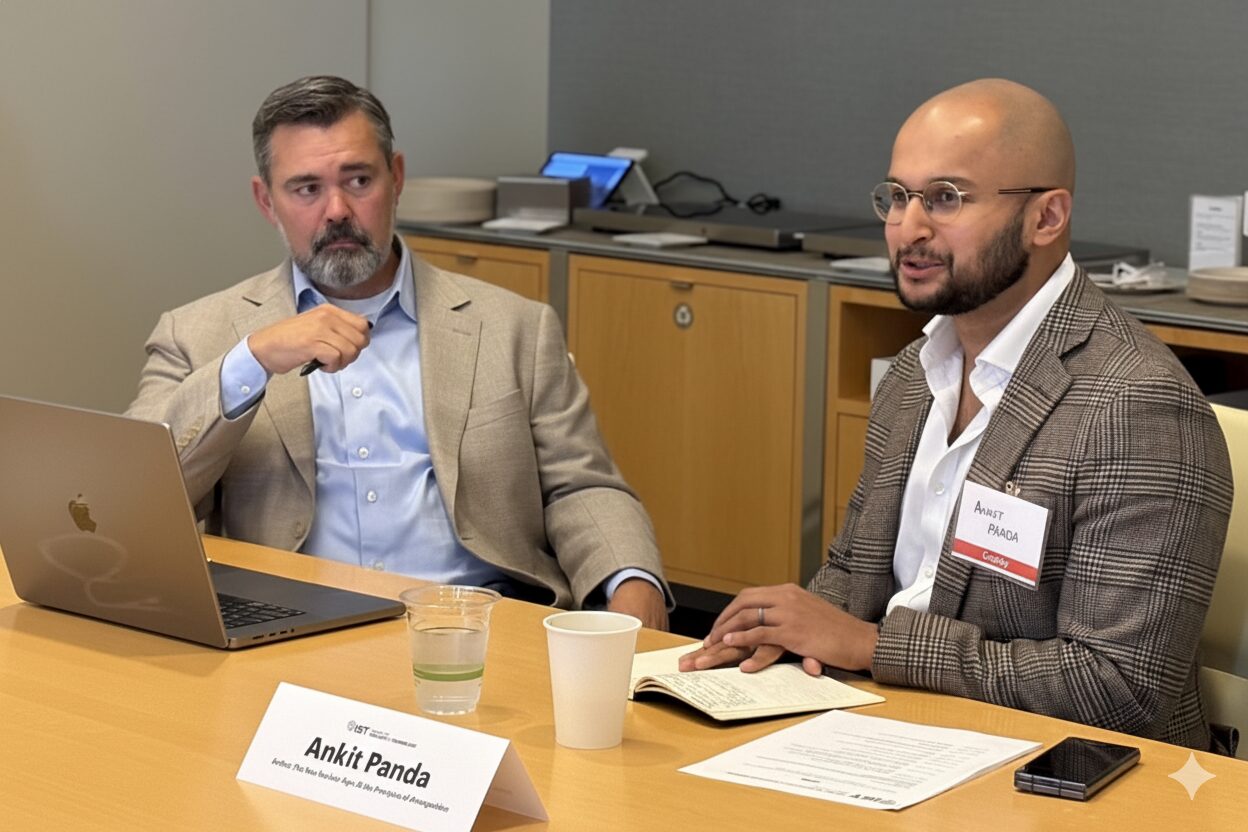
The New Nuclear Age: At the Precipice of Armageddon – IST Hosts Book Talk with Author Ankit Panda
IST’s Nuclear Policy team hosted international security expert and author Ankit Panda in Palo Alto to learn more about his latest book unpacking the trilateral nuclear competition between the United States, China, and Russia. IST CEO Philip Reiner sat down for a fireside chat with Ankit, highlighting in their discussion the need to collectively identify political and technical solutions to address the nexus of emerging technologies and the new nuclear age.
AI
,
and communications
,
artificial inteligence
,
China
,
control
,
NC3
,
nuclear
,
nuclear command
,
nuclear risk
,
Russia
,
United States
November 17, 2025
Report
The Phone-a-Friend Option: Use Cases for a U.S.-U.K.-French Crisis Communication Channel
This brief outlines the case for a multilateral crisis communication channel between the heads of state of the United States, the United Kingdom, and France.
France
,
nuclear crisis communications
,
United Kingdom
,
United States
June 26, 2024
Report
Communication Disruption Attacks on NC3
In an essay out of the workshop "Last Chance: Communicating at the Nuclear Brink," Paul Bracken argues, "in a nuclear world we should be careful about attacking enemy communications because doing so leads to greater risks of uncontrolled escalation. The worst possible situation is the one the United States is now in, that is, to not be clear in our own minds about what we are doing when it comes to disrupting communications.”
CATALINK
,
communication
,
communication attacks
,
electromagnetic pulse
,
electronic warfare
,
escalation
,
military
,
NC3
,
nuclear
,
red line
,
retaliation
,
strike
,
target
,
targeting
,
United States
,
vulnerability
May 28, 2020
Report
Turkey and Nuclear Command, Control, and Communications
Can Kasapoğlu argues that in contrast to the other four NATO nuclear delivery states, Turkey no longer appears to have an active nuclear weapons delivery mission using bombers and its NC3 system is likely dormant. "Yet," he concludes, "in a hypothetical TNW scenario, the Turkish Air Force would manage the Incirlik base and air traffic for the US air wing, and would probably provide the strike package with fighter escort. In fact, the strong separation between active combat (the US) and support roles (Turkey) could be a complicating factor for the NC3 in real warfighting...
air base
,
Ankara
,
C4ISR
,
cold war
,
Middle East
,
missile
,
NATO
,
NC3
,
nuclear
,
nuclear delivery state
,
squadron
,
stability
,
Turkey
,
United States
June 27, 2019
Report
An Examination of the US NC3 Industrial and Innovation Base
Colonel Elvert Gardner examines the U.S. industrial and innovation base, identifying key factors that may militate against innovation and against timely and efficient supply in the US industrial base.
Aquisition
,
cybersecurity
,
Department of Defense
,
DOD
,
human capital
,
industrial base
,
innovation
,
modernization
,
National Defense Authorization Act
,
national security
,
nuclear
,
stability
,
supply chain
,
United States
June 20, 2019
Report
Command and Control of Nuclear Weapons in India
M.V. Ramana and Lauren Borja analyze the state of nuclear command and control in India, concluding that the state of Indian NC3 “has been shaped by an ongoing rivalry between civilian authorities and the military."
accident
,
communication
,
control
,
decision-making
,
defense
,
delivery vehicle
,
deterrence
,
early warning
,
India
,
military
,
NC3
,
nuclear
,
Pakistan
,
stability
,
submarine
,
survivability
,
United States
,
wargaming
August 1, 2019
Report
Nuclear Command, Control, and Communications: U.S. Country Profile
In "Nuclear Command, Control, and Communications: U.S. Country Profile," Jeffrey Larsen argues that, for the last 75 years, the deterrence forces of the United States have relied on the credible threat of nuclear weapons use to prevent adversarial attacks.
authority
,
C2
,
command
,
communication
,
control
,
deterrence
,
NC3
,
nuclear
,
policy
,
president
,
stability
,
strategic
,
Strategy
,
United States
,
US
,
World War II
August 22, 2019
Report
The Non-State Dimensions of Nuclear Command, Control, Communications
Dr. Gary Ackerman introduces how violent non-state actors (VSNAs) may approach the command and control of nuclear weapons and suggests that understanding the complexity presented by VNSA NC3 entails considering traditional concepts of state NC3 and dynamics that are unique to non-state actors driven by a variety of goals and confronting a different set of constraints from those of states.
biological
,
casualties
,
casualty
,
chemical
,
cold war
,
conventional
,
detection
,
fail deadly
,
fail impotent
,
fissile
,
leadership
,
NC3
,
non-state actor
,
nuclear
,
organization
,
psychology
,
Russia
,
scenario
,
Secretary of Defense
,
stability
,
strategic
,
terrorism
,
terrorist
,
United States
August 29, 2019
Report
Eye See You
Over the past several decades, technological innovation has created many opportunities for multinational corporations and government institutions to serve customers globally, be it individuals, brands, governments, and civil society. Yet, this innovation has brought with it enormous responsibility and a challenge to protect both individual and consumer privacy, writes Vera Zakem.
China
,
data protection
,
democracy
,
European Union
,
facial recognition
,
GDPR
,
Russia
,
United States
June 10, 2020
Search
Search
MENU
HOME PAGE
About
FAQ
The CATALINK Brief
Insights
Events
Analysis
Podcasts
Why crisis communications?
Our Team
GET IN TOUCH
Email:
[email protected]
Send us a message:
Contact
JOIN THE CATALINK MAILING LIST
First Name
Last Name
Organization
Email
Subscribe